

Brown Statuario Marble Slabs: Why a Small Sample Hides the Real Stone
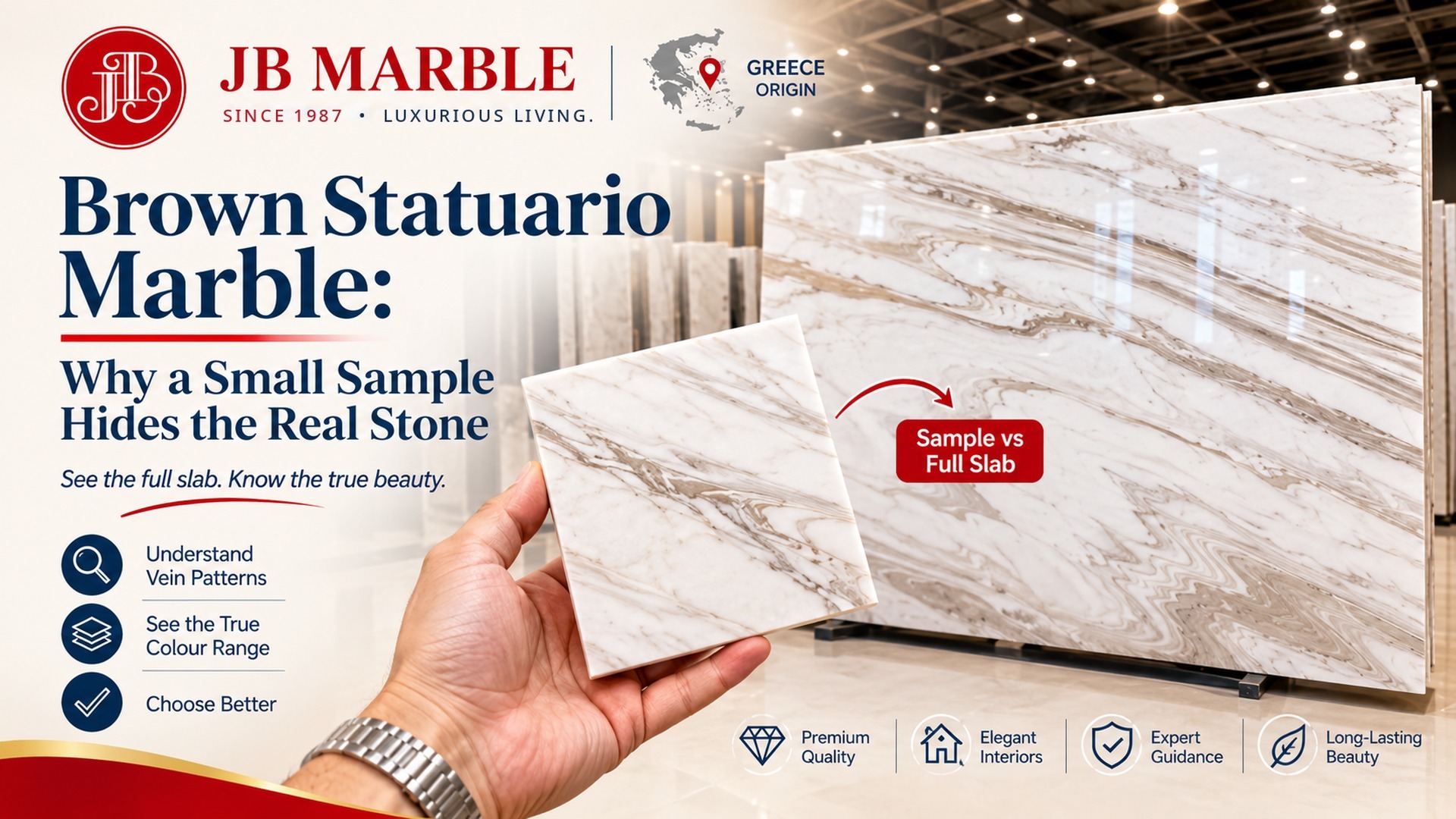
Most buyers first meet Brown Statuario Marble as a piece that fits in one hand. A polished chip travels to the site. The family passes it around, photographs it on a phone, and approves it — weeks before anyone stands before the stone. For a plain, quiet marble, that order can survive. For brown statuario marble slabs, it reverses cause and effect: the smallest, least honest view of the stone takes the project’s largest decision.
This is not a warning against samples. It is a measurement of what a sample is. A standard chip measures about 10 by 10 centimetres; a full slab of this Greek stone covers roughly six square metres. The chip shows less than 0.2 percent of one slab — and a floor needs ten or more slabs. This guide shows, scale by scale, what that fraction leaves out.
It is written for homeowners approving stone from a sample, and for the architects and builders who must lock the full lot. Its bottom line is simple: a chip can start this selection, but only the full slab and the full lot can finish it.
Quick Answer:
A small sample of Brown Statuario Marble shows the stone’s finish and its local colour honestly, but it cannot show the three things that decide how brown statuario marble slabs actually look in a room: the sweep of the diagonal veins at full scale, the warm range of the ground across a full lot, and the stone’s true colour outside a phone photograph. Approve this stone at full scale instead — full slab upright, full lot in sequence, and a written record — using the 3-Scale Check in this guide.
Key Takeaways
- A 10 × 10 cm sample chip is about 0.01 m² — under 0.2% of one full slab, and a vanishing fraction of a lot.
- This stone's brown and grey bands run diagonally at a scale a chip cannot hold — inside one band, or between two, it reports both falsely.
- The ground of a lot moves between bright white and warm cream from slab to slab; one corner of one slab cannot promise the range.
- Phone cameras cool warm stone down: automatic white balance shifts this marble's cream ground towards grey.
- For brown statuario marble slabs, stone-industry guidance treats samples as range references, not approvals — sample, slab and lot approval are three separate acts.
- The stone carries numbers no chip displays: about 92% dolomite, density 2.82 g/cm³, absorption 0.19% — the fingerprint of the real Greek material.
Who This Guide Is For
This guide is for homeowners who are about to approve Brown Statuario Marble for a home, for architects and interior designers whose clients confirm stone on phone photographs, and for builders who must lock a full lot for flooring or wall cladding on a deadline. Use this guide at three decision points in a residential interior project. First, when a sample arrives and the family wants to say yes too quickly. Second, when slab photographs land on WhatsApp and the ground looks different from the sample. Third, when you stand at the lot and must decide what to check before anything is cut.
1. A Sample Is a Crop, Not a Portrait
A photograph cropped to one corner is still a truthful photograph — of the corner. A marble sample works the same way. It is a genuine piece of the stone, cut small, and everything it says is true about the few square centimetres it covers. The error is never in the chip. The error is in the promotion the chip receives, from reference to representative.
The Arithmetic of a Chip
| View | Surface It Shows | What It Can Honestly Prove |
|---|---|---|
| Sample chip, 10 × 10 cm | About 0.01 m² | Finish, polish quality, local colour, how the stone feels |
| One full slab | Roughly 6 m² | The full vein sweep, the ground across one slab, bookmatch potential |
| A full lot in sequence | 60 m² and more | The range of the ground, slab-to-slab consistency, the real floor |
Read the first row against the second and the problem states itself. In short, the chip is not a small version of the slab. It is a different category of evidence. It belongs to the beginning of a selection, where finishes and families are compared — not to the end, where a floor is approved.
Sample Approval Is Not Slab Approval
Stone-industry selection guidance makes the same distinction formally: a sample is a range reference, while the actual slabs proposed for a project are reviewed and approved separately. In practice, three approvals exist — of the sample, of the slab, and of the lot — and only the third protects a floor. A buyer who has done only the first has approved a rumour of the stone, not the stone.
2. Pattern Scale: The Sweep a Chip Cannot Hold
The identity of brown statuario marble slabs is movement. Broad diagonal bands of brown and grey cross a white-to-warm-cream ground. They formed as pressure folded the Volakas stone of Drama, in north-eastern Greece. The bands run at the scale of the slab itself. A single band can travel from one corner of a slab to the other. Meanwhile, the quiet field between two bands can be wider than a sample chip is long.
One Window, Two False Reports
Place a 10 cm window on this pattern and it can land in exactly two misleading positions. Inside a band, the chip reads as a brown marble — dark, dramatic, and nothing like the balanced slab it came from. Between bands, the same chip reads as a plain warm white — calm, safe, and equally false. The full slab is neither of those stones; it is the conversation between band and field, and that conversation only exists at full scale.
Direction Lives at Full Scale Too
A floor in this marble is designed, not just covered: the diagonal is run with the room’s length, or across it, and feature walls are bookmatched from consecutive slabs. None of that is visible on a chip, because a chip has no direction worth the name — it can be turned in the hand until any reading seems possible. Direction, sweep and bookmatch are properties of slabs, approved only where they exist: on the slab.
3. Ground Scale: White Here Does Not Mean White Everywhere
Ask a room of buyers what colour Brown Statuario is and the sample will answer for them: white. The full lot gives a longer answer. Across the slabs of one block, the ground of this stone travels — bright white on one slab, warm cream on the next, a breath of ivory between them. Geologists expect exactly this: marble is a natural material whose mineral balance shifts as the original rock changes, and no quarry issues two identical blocks.
One Corner Cannot Promise a Lot
The yard cuts a chip from one corner of one slab. That corner’s ground then freezes as the stone’s promise. The promise breaks politely, slab by slab, as the cream deepens where the sample said white. Nothing has gone wrong — the lot was always a range; what went wrong was approving a range from a single point inside it. Honest yards show range samples — the lightest and deepest slabs side by side — because the range, not the point, is what a floor is made of.
Warmth Is the Point of This Stone
The warm drift is not a defect to be negotiated away. It is precisely why buyers choose this marble over colder white stones: the cream in the ground lets it sit with warm woods, brass and evening light. The approval task is not to demand the sample’s exact white everywhere. That demand is impossible. Instead, approve the full warm range knowingly. Then place the deeper slabs where the design wants depth.
4. Photo Scale: Approving Brown Statuario Marble Slabs on a Phone
Most Brown Statuario approvals today happen in a chat window: a photograph of the sample, judged on five different screens under five different lights. Each step moves the colour, and for a warm-ground stone, every move is in the same wrong direction: cooler.
What the Camera Does to Warm Marble
A phone camera constantly corrects colour towards neutral, a process called automatic white balance. Home lighting is warm, around 2700 to 3000 Kelvin. Daylight sits nearer 5500 to 6500. Faced with a warm cream ground under warm light, the camera decides the warmth is an error. It then removes it. The stone in the photograph arrives greyer and colder than the stone in the hand. Add screen brightness, night-mode warmth on the viewer’s phone and chat-app compression, and the family is approving a fourth-generation copy of the colour.
How to Make a Photograph Behave
Photographs still have a job — shortlisting, sharing, recording — if they are taken under discipline:
- Whole slab, edges visible: A cropped photograph restarts the sample problem at a larger size; the full face, corner to corner, is the minimum honest frame.
- A scale reference in frame: A person, a tape or a door beside the slab restores the pattern's true scale.
- One consistent light: Photograph every slab of the lot in the same light, ideally open daylight, never a mix of tube light and window light.
- Original files, not forwards: Every forward through a chat app compresses the image further; ask for the original file for any decision that matters.
5. The Numbers a Sample Never Shows
A chip also hides the stone’s identity papers. Brown Statuario is the Indian market’s name for the dolomitic marble of Volakas, Drama. Its laboratory fingerprint is published and precise. The Hellenic Survey of Geology measured it, and the EuroLithos laboratory data for Volakas Drama White compiles it. Any lot can be checked against those numbers.
The Fingerprint, in Numbers
| Property | Volakas (Brown Statuario) Value |
|---|---|
| Mineral composition | Dolomite about 92%, calcite about 8% |
| Density | 2.82 g/cm³ |
| Water absorption | 0.19% by weight |
| Compressive strength | About 139 MPa |
| Flexural strength | About 10 MPa |
These numbers matter at approval for two reasons. First, identity. A dolomite marble at 2.82 density and 0.19% absorption is measurably different from the softer calcite whites. Therefore, a lot that cannot be traced to this fingerprint deserves questions. Second, behaviour: that low absorption is why the stone performs as it does on floors and in bathrooms. A sample chip displays none of this. Someone can cut it from the right stone or the wrong one, and the hand cannot tell the difference.
6. The 3-Scale Check: How to Approve This Stone Properly
Approval done properly is not slower; it is merely done in the right order. For brown statuario marble slabs, three steps, one per scale, replace the chip’s single false verdict with the stone’s real one.
Step One: The Full Slab, Upright
Stand the slab up and step back until the whole face fits your view. Read the sweep first — where the bands run, how much of the slab is band and how much is field — then walk closer and read the ground. This is the only view in which pattern scale exists, and for Brown Statuario Marble it is the view the room will actually live with.
Step Two: The Lot, First to Last
Then read the range: the first, middle and last slabs of the lot, side by side in one light. You are approving the ground’s full journey, from white to warm cream. You are also confirming that the vein family holds across the sequence. It is the same discipline as Statuario marble lot selection, applied to a warmer stone. If the range pleases you as a range, the floor will please you as a floor.
Step Three: The Record, Before Cutting
Finally, freeze the approval in a record: the lot reference, the slab count, photographs of the first, middle and last slabs, and the approved range noted in writing. The record is what travels to the cutting plan, and it is what settles any later question about what was approved — memory argues, records answer.
From Our Own Racks at Jigani
At our Jigani gallery, we see the same approval mistake repeat every week. A buyer sends us a WhatsApp photograph of a sample chip. Then comes the question: does the lot match it? We never answer that question from a photograph. Instead, we walk the buyer to the lot itself. Our lot card records the block reference, the slab count and the sequence. It also holds photographs of the first, middle and last slabs. In our experience, buyers who make that one trip approve in twenty minutes what a month of photographs could not settle.
7. When a Sample Is Still the Right Tool
None of this retires the sample. It simply returns the sample to its honest jobs, and removes it from the one job it cannot do.
What a Sample Decides Well
A chip is the right tool for finish: polished against honed, felt in the hand and read in raking light. It is the right tool for pairing, carried to the cabinet maker to test the marriage of materials. And it is the right tool for family alignment early in a project, when the question is only which family of stone the home wants.
What a Sample Must Never Decide
It must never decide the pattern of a floor, the ground of a lot, or the true colour of brown statuario marble slabs judged from a phone screen. Those three decisions belong to the slab, the lot and the record. Give each decision to the scale that can actually carry it, and the sample becomes what it should always have been: the first word of the selection, never the last.
Frequently Asked Questions
Can I approve Brown Statuario Marble from a sample piece alone?
No. A sample honestly shows finish and local colour. However, it covers under 0.2% of one slab. So it cannot show the vein sweep, the lot’s warm ground range, or the stone’s behaviour at room scale. Use the sample to shortlist, then approve the full slabs and the full lot before cutting.
Why does a sample of this marble look lighter than the full slab?
Two reasons. The chip may be cut from a bright corner of its slab, while the lot’s ground travels from bright white to warm cream across its slabs. And a phone photograph cools the warm ground further through automatic white balance, so the sample’s image arrives lighter and greyer than the stone itself.
Can a phone photograph replace seeing the slab in person?
It can support a decision, but it cannot carry one. A disciplined photograph is still good evidence for shortlisting and recording. It must show the whole slab, edges visible, with a scale reference in frame and one consistent light. And it must travel as an original file. Final approval, however, belongs to the full slab, seen upright, in person.
How many slabs should I see before approving a lot?
At minimum, three: the first, the middle and the last slab of the lot, side by side in one light. Those three show the ground’s full range and whether the vein family holds across the sequence. For bookmatched or feature work, also see the exact consecutive pair that will be cut.
What should be recorded when I approve the slabs?
Record the lot reference, the number of slabs, photographs of the first, middle and last slabs, the finishes chosen, and the approved ground range in writing. That record travels with the cutting plan and settles any later question about exactly what was approved.
Is a sample of Brown Statuario Marble good for anything?
Yes — three things. It decides the finish, polished or honed, better than any photograph. It tests pairings against wood, fabric and other stones at the design table. And it aligns the family early, before the serious work of slab and lot approval begins.
Approve the Stone You Will Actually Live With
After all, nobody lives with a sample. You will live with ten slabs of warm, moving stone. They will lie in sequence, lit by your own rooms. That stone deserves approval at its own scale. Keep the chip for what it knows, demand the slab for what it decides, and brown statuario marble slabs will show you at approval exactly what they will show you at home.
Last updated: 11 November 2026 · JB Marble, Bengaluru
Explore Brown Statuario Marble With JB Marble
JB Marble — Luxurious Living.
At our 250,000-square-foot luxury marble gallery in Jigani, Bengaluru, hand-selected blocks are processed in-house and displayed as complete lots, so the slabs you approve are the slabs that reach your home. Visit the gallery to approve this stone at full scale, or speak with our team for guidance on your project.