

Amazonite Quartzite
Brazilian Quartzite With Gemstone Crystals — Teal Fields in a Quartz Ground
- Natural Brazilian Quartzite
- Amazonite Crystal Fields
- Full Slabs, In Quantity
- Colour Grown, Never Printed
PRICE
On Request
Contact JB Marble for current price, slab availability, dimensions and finish options.
MaterialNatural Quartzite (Metamorphic)
Identity
Natural Stone, Not Engineered Quartz
Primary Colour
Turquoise-Teal
Pattern
Crystal Mosaic
Amazonite at First Sight
Quick Answer: Amazonite Quartzite is a natural Brazilian quartzite whose turquoise-teal colour comes from amazonite, a green feldspar mineral grown as large crystals inside a quartz-rich rock. It is stocked in full slabs at JB Marble, Bengaluru, for feature walls, kitchen islands, vanities and bar counters. Price on request — contact +91 9828 007 007.
Some stones wear their colour as an accident — a vein that wandered in, a stain that settled. Amazonite Quartzite carries its teal in its crystals. The mineral amazonite formed inside this quartzite as the rock itself formed, so the colour occupies the slab’s full thickness. Saw the edge, or polish the surface again in twenty years, and the teal is still there.
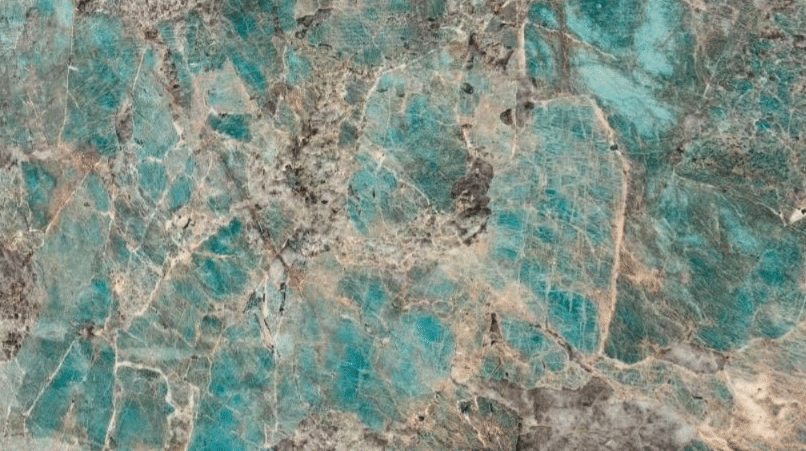
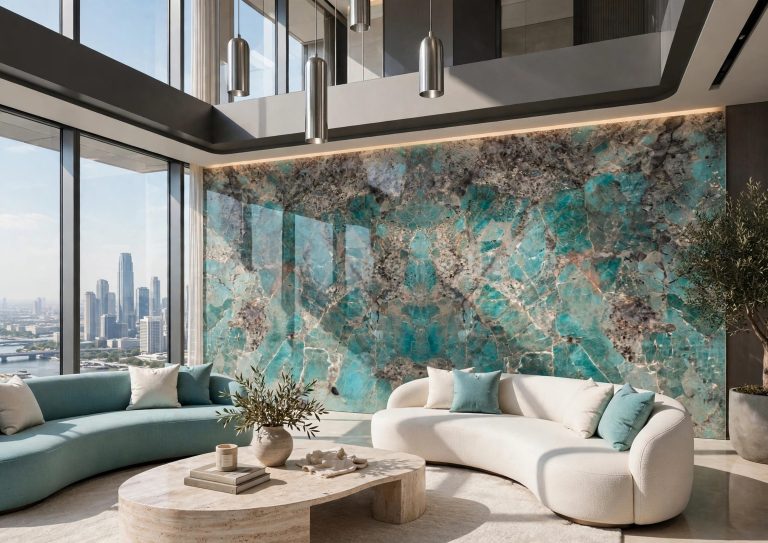
Across the face, large teal crystals interlock like pieces of a mosaic. A grey-brown quartz ground holds them together, fine white streaks cross the crystal fields, and rust-gold threads warm the whole composition. Stand back and the slab reads as one bold artwork; step close and it reads as geology. Very few stones hold an entire room from a single wall the way this one does.
Who Should Read This Page Before Ordering
Homeowners planning one unforgettable surface will find this page written for them. So will the architects and interior designers who must specify that surface with confidence, and the builders who lock a lot before cutting begins. Use it when Amazonite Quartzite is on your shortlist and you want the facts settled before the quotation. Use it, above all, when an online listing offers this name at a fraction of gallery cost.
Key Takeaways
- Amazonite Quartzite is a natural Brazilian quartzite. Its teal is the mineral amazonite itself, grown as crystals through the full thickness of the slab.
- JB Marble stocks it in full slabs, in quantity — original Brazilian material, selected as blocks and processed in-house.
- The name also covers engineered quartz prints and assembled gemstone panels in India. Read the edge of the slab: natural crystal continues through; a print ends at the surface.
- Hardness sits in the quartzite range at Mohs 6.5–7, so islands, counters and vanities take daily use in stride.
- Every block composes its crystal mosaic afresh; therefore approve the actual slabs at the gallery, never a photograph alone.
One Name, Three Products in India
Answer: In India today, “Amazonite” names three different products — this natural Brazilian quartzite, an engineered quartz that prints a similar pattern, and an assembled semi-precious panel built from small gemstone pieces. Only the first is a natural slab(Amazonite Quartzite), and the difference is visible at any cut edge.
- Natural quartzite: Crystals grew inside rock in Brazil; the teal continues through the full 18 or 20mm of the slab
- Engineered quartz: A manufactured body carrying an Amazonite-like print on its surface — the pattern ends at the edge
- Assembled panels: Small gemstone pieces set together as a decorative sheet — a craft product, not a quarried slab
Inside the Stone: Crystals in a Quartz Frame
Amazonite spent most of its history in jewellery boxes. Craftsmen in ancient Egypt set the green feldspar into amulets more than five thousand years ago. Gem cutters still shape it into cabochons and beads today. The mineral is a green variety of microcline, a potassium feldspar, and its colour puzzled science for years. Eventually, a 1985 study traced the blue-green to traces of lead and water locked inside the crystal. Wikipedia’s mineral entry on amazonite records that finding.
In Brazil, those same crystals grew inside a quartz-rich rock under heat and pressure. The gemstone therefore never sits alone in this stone. Instead, large teal crystals interlock with grey quartz, fine white streaks and dark mica flecks. The result is a true quartzite that carries a gemstone’s colour at architectural scale. Consequently, one slab composition can cover a double-height wall without repeating itself.
The name, meanwhile, promises a river the stone never met. Amazonite was named for the Amazon, yet the classic mineral does not come from that basin. This slab quartzite, meanwhile, is quarried in Brazil. We tell the story plainly because buyers deserve the stone’s real biography, not a brochure myth.
The White Streaks Are the Signature
Look closely at any teal field and fine white lines cross it. That white is albite, a second feldspar that grew inside the amazonite crystals as they formed. Printers can copy a colour, but they cannot copy a crystal growing inside another crystal. When you see those streaks at the gallery, you are looking at the stone’s own certificate of birth.
Read the Edge, Know the Stone
Every identity question about this name ends at the slab’s edge. On natural Amazonite Quartzite, the teal crystals continue through the full thickness, and the cut edge shows the same mosaic as the face. On an engineered print, the pattern sits on the surface and the edge shows a plain manufactured body. Our team turns the slab and shows you that edge before you commit to a single piece.
The Numbers, Exactly as Published
| Specification | Details |
|---|---|
| Product Name | Amazonite Quartzite |
| Brand | JB Marble |
| Stone Type | Natural quartzite — a quartz-rich rock carrying amazonite feldspar crystals |
| Origin | Brazil — original Brazilian material |
| Primary Colour | Turquoise-teal crystal fields over a grey-brown quartz ground |
| Pattern | Crystal mosaic; every block composes it afresh |
| Pattern Layout | Laid slab by slab from one lot — a mosaic stone, not a bookmatch pattern |
| Also Listed As | Amazonite Green Quartzite, Blue Amazonite Quartzite, Tiffany Blue Amazonite — trade names for the same stone |
| Mohs Hardness | 6.5–7 for the quartz framework; the amazonite crystals themselves rate 6–6.5 |
| Density | 2.65–2.75 g/cm³ |
| Water Absorption | 0.2%–0.4% by weight — low |
| Compressive Strength | 160–200 MPa (typical published range for this material) |
| Slab Thickness | 18mm and 20mm — confirm the running lot at selection |
| Finishes | Polished, Honed and Leathered — confirm the running lot at selection |
| Format | Full slabs, stocked in quantity at the Jigani gallery; cut-to-size pieces fabricated in-house |
The figures above are published values for this material family, stated as ranges because natural quartzite varies from one quarry bench to the next. In fact, they describe the stone honestly. The current lot’s own details are then confirmed with you at the gallery, before you commit.
What the Crystals Do for a Room
Answer: Amazonite Quartzite brings a colour no other material in the gallery can offer — a teal grown inside feldspar crystals, carried on a quartz-hard frame. It adds mosaic compositions that never repeat, warm mineral threads that pair with brass and wood, and a surface built for daily use.
Colour With a Mineral Address
Grown Colour, Full Depth
The teal is not applied to this stone; it is the stone. Amazonite crystals took their colour as they grew, deep inside the rock. Cut it, edge it, re-polish it — every fresh face shows the same teal. The colour lives in the crystal structure itself.
A Quartz-Hard Working Surface
Quartz forms the frame of this stone, and quartz rates 7 on the Mohs scale. As a result, knives, keys and daily utensils leave the surface unbothered in normal use, year after year.
Low Absorption, Easy Temperament
Absorption stays between 0.2 and 0.4 percent, which is low for a natural stone. Spills therefore rest on the surface instead of sinking into it, and a sealer refreshed on schedule keeps them resting there.
One Composition, Never Repeated
Crystal growth answers to geology, not to a design department. Every block therefore composes its mosaic afresh. The composition you approve exists in that lot alone — no second block will ever grow it again.
Warm Threads That Pair Easily
Rust-gold mineral threads run along the crystal boundaries, warming the cool teal. They pair naturally with brushed brass, bronze, oak and walnut — the metals and woods Indian luxury homes already love.
A Soft Glow Under Light
Polished teal fields return room light with a soft crystal depth, so a wall reads almost liquid under evening lighting. The effect belongs to the crystal structure itself; no coating creates it.
The Same Stone in Three Registers
Answer: Three finishes bring out three different stones from the same slab. Polished is the extrovert, all glow and saturation. Honed is the introvert, matte and architectural. Leathered sits between them, textured and tactile. The current lot’s finishes are confirmed with you at the gallery.
Polished Finish
Mirror-bright and fully saturated. The teal fields deepen, the white streaks sharpen, and the wall behaves almost like artwork under glass. This is the finish for surfaces that are meant to be looked at.
Honed Finish
Silky, flat and calm. Honing takes the shine away and leaves the mosaic reading as pure pattern, which suits bright rooms and large panels. Fingerprints and reflections both stay out of the picture.
Leathered Finish
Brushed into a soft relief that fingers can feel. The texture grips light unevenly across the crystal fields, so the surface keeps changing as you move. Prepared on selected lots for counters and vanity tops.
Where the Teal Belongs
Answer: Give this stone the lead role in one place per room, and it rewards you every day. Its proven seats are the feature wall, the kitchen island, the bathroom vanity, the bar counter, the dining table and the reception front.
One Lead Role in Every Room
Feature Walls
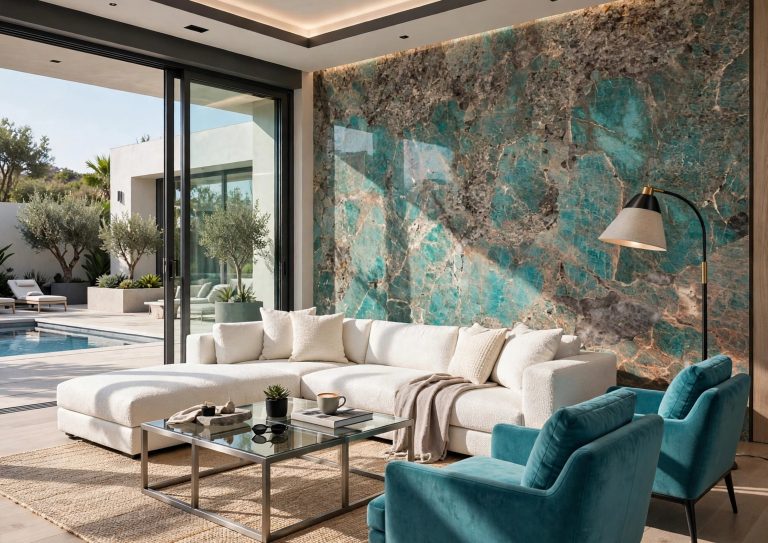
The signature use of this stone. One slab composition covers the wall, so the mosaic reads as a single artwork instead of a repeated pattern — living rooms, double-height walls and entrance walls carry it best.
Kitchen Islands
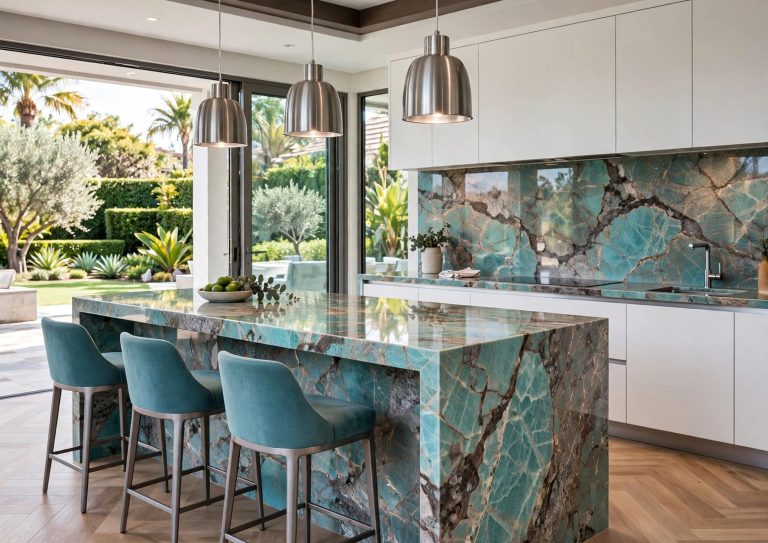
An Amazonite island turns the kitchen into the house's gathering point. The quartz framework takes daily cooking in stride, while the teal pairs beautifully with white cabinetry, oak and brushed brass.
Vanities & Bathrooms
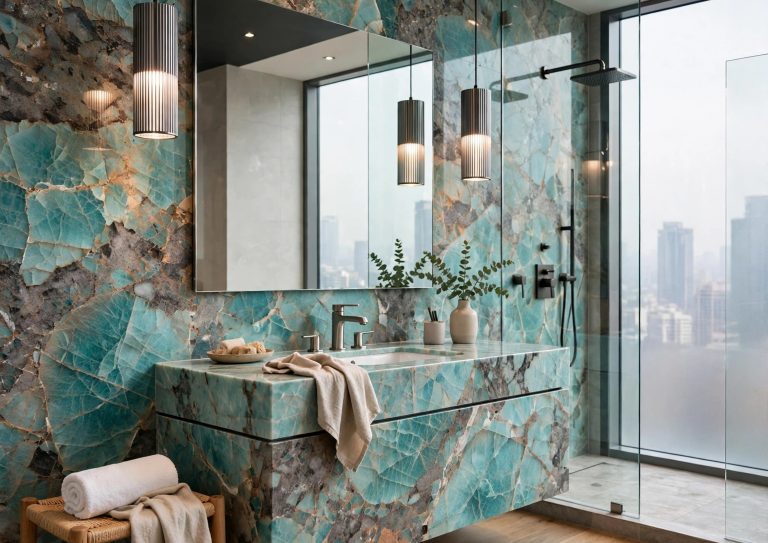
A vanity cut from this stone gives a bathroom a boutique-hotel register. The honed finish suits wet zones gracefully, and the crystal fields reward the close viewing that bathrooms naturally invite.
Bar & Reception Counters
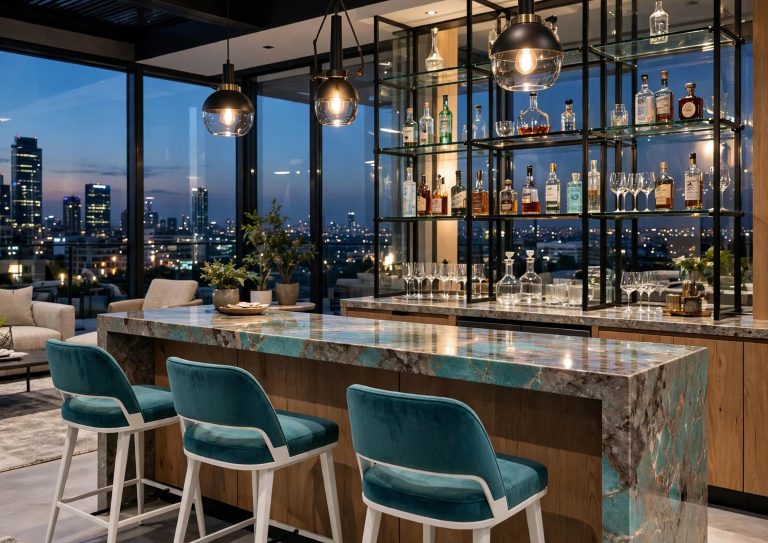
A bar front in this stone becomes the room's meeting point before the first drink is poured. Hotels and lounges use it for the same reason home bars do. The teal glows under warm light, and guests remember the address by it.
Dining Tables & Consoles
Tabletops show the mosaic at touching distance, where the white albite streaks inside the crystals finally become visible. Guests always end up running a hand across it.
Commercial Interiors
Boutiques, salons and premium offices use one Amazonite surface as their identity wall or counter. The colour photographs memorably, and no competing premises can copy the exact composition.
Planning a Wall of Crystal Mosaic
A mosaic wall is decided long before the first slab is cut. Which slab stands at eye level, which one disappears behind the sofa, where the joins fall — these choices are the design. Because Amazonite’s pattern is a crystal mosaic rather than a mirrored pair, the layout is planned across the lot as one continuous field. Four decisions make the difference:
- Give eye level the richest crystals: The slabs with the deepest teal coverage belong at the centre of the wall, where eyes rest longest. Quieter, ground-heavy slabs earn the edges, the returns and the space behind furniture.
- Walk the sequence before cutting: The chosen slabs are stood in their wall order at the gallery, and you read the whole composition at full size. Anything that jars is swapped while swapping is still free.
- Let joins follow crystal boundaries: Fix every cut line with the mosaic in view, so fabrication respects the natural edges of the crystal fields.
- Light it warm: Warm lighting wakes the rust-gold threads and deepens the teal; plan the wall's light before the first cut, not after it.
The plan is marked in chalk on the slabs themselves, so the wall you approved at the gallery is the wall that arrives at your site.
Neighbours That Flatter the Teal
A colour this confident needs quiet company. Keep the surrounding palette calm — warm whites, pale oak, matte black and brushed brass all step back and let the crystal fields lead. Busy neighbours, by contrast, fight the mosaic and cheapen both surfaces.
If your plan pairs a statement green with a quieter Brazilian quartzite, judge Cristallo Patagonia in the same visit. Its grey-white crystal fields calm a room that Amazonite excites, and the two stones together cover a home’s loud and quiet rooms with one family resemblance.
Care That Takes Minutes, Not Weekends
Care for Amazonite Quartzite is a short routine, not a project. The stone is sealed at installation, and that single habit does most of the protective work for the year ahead. Quartzite asks for less than marble does, because its framework is harder and its absorption is lower.
- Daily: A pH-neutral cleaner and a soft cloth — the surface needs nothing stronger.
- Spills: Wipe strong colours — haldi, coffee, red wine — within a reasonable while rather than the next morning.
- Avoid: Harsh acid-based cleaners, which dull any natural stone's polish over time.
- Yearly: Refresh the sealer about once a year, as a routine, before it ever becomes a rescue.
Follow that much, and the teal your guests admire in year one is the teal they admire in year ten.
How a Lot Gets Approved Here
Walk the lot at full size. Photographs flatten this stone’s depth, so approval happens standing before the slabs themselves. Take your time; a lot decision made in twenty unhurried minutes saves every later regret.
Fix your colour balance. Some slabs run teal-heavy, while others let the grey-brown ground lead. Neither is better — however, the balance must match the room you imagined, so name it clearly before slabs are marked.
Read the edges. Ask the team to show you a cut edge on the lot. Natural crystals continue through the full thickness there; that one glance settles the stone’s identity beyond argument.
Mark slabs room by room. The team chalks each chosen slab for its destination — wall, island, vanity — while you watch. As a result, the composition you approved is the composition that reaches fabrication.
Reserve before cutting. Once your slabs are marked, the lot is held for your project alone. Cutting begins only after that reservation, never before it.
Why This Stone Has No Rate Card
Amazonite Quartzite is quoted per lot, never from a printed rate card. No two lots carry the same crystal coverage, after all, and coverage is exactly what you are paying for. A printed figure would price an average stone that does not exist.
The Eight Factors Inside Your Quotation
| Factor | How it affects the quotation |
|---|---|
| Origin and material identity | Natural Brazilian quartzite, solid through its full thickness — never engineered quartz or an assembled gemstone panel |
| Crystal coverage | How much of the slab the teal fields claim, and how the white streaks run through them |
| Dimensions | Slab size measured against the cutting plan for your rooms |
| Thickness | 18mm or 20mm, matched to the application |
| Finish | Polished, honed or leathered surface processing |
| Quantity | Total area, plus the slabs reserved for your project including spares |
| Transportation | Distance from Jigani, handling care and site delivery arrangements |
| Installation | Fabrication, laying and finishing scope for your project |
Amazonite Quartzite in Bangalore
In Bangalore, Amazonite Quartzite is displayed at JB Marble’s gallery in Jigani. The 250,000-square-foot luxury marble gallery keeps complete lots standing in sequence under open light. Walk the lot slowly, slab by slab. Set one lot against the next as you walk. The difference in crystal coverage, block to block, becomes easy to judge. Read a cut edge as you pass, and the crystals confirm themselves through the full thickness. Then mark the exact slabs for your rooms and reserve them before cutting begins.
Amazonite Quartzite in Kishangarh
Many buyers first meet this name while searching the Kishangarh market, where exotic material changes hands lot by lot. Under this one name, though, three products circulate — natural quartzite slabs, engineered quartz prints and assembled gemstone panels. The comparison that matters there is simple. Ignore the sticker and read the edge: natural crystals run through the full thickness. A print, by contrast, stops at the surface. At JB Marble, the Amazonite lot comes from blocks our team selects in Brazil and processes in-house. The lot you inspect at Jigani is one block’s material — complete, consistent and exactly the stone described on this page.
Four Quartzites, Four Temperaments
The Difference Is in the Crystal
All four stones below are Brazilian quartzites, and all four sit in the same hardness family. What separates them is temperament — the colour each crystal carries, and the kind of room that colour wants to live in.
| Feature | Amazonite Quartzite | Cristallo Patagonia | Patagonia Quartzite | Taj Mahal Quartzite |
|---|---|---|---|---|
| Colour story | Turquoise-teal fields on a grey-brown ground | Grey-white crystal fields with taupe-grey bands | White-grey ground with bold black mineral patches | Warm ivory with soft gold veining |
| Pattern language | Crystal mosaic | Flowing crystal strata | Large crystal patches | Gentle, marble-like veins |
| Colour source | Amazonite feldspar crystals | Quartz crystal fields | Quartz with dark tourmaline | Quartz with gold mineral traces |
| Best seat in the house | Feature walls, islands and bars that must be remembered | Walls and counters in quiet, layered rooms | Statement walls that can carry contrast | Kitchens and warm, classic interiors |
| Character in one line | The jewel of the family | The calm crystal | The bold patchwork | The warm classic |
All four sit in the quartzite hardness range, Mohs 6–7. Choose by temperament first; the performance follows the family.
Why JB Marble for a Stone Like This
Since 1987, JB Marble has worked one way: our own team selects blocks at source quarries around the world, and our own factory turns those blocks into finished slabs. Amazonite reaches Jigani by that same road. Consequently, the lot you approve is the lot our team chose at the quarry. It is not a consignment a trader happened to receive.
Read at the Block, Before It Travels
An Amazonite block is read before it is bought, and the reading has three questions. How much of the block face do the teal crystals claim? Do the white albite streaks run through those crystals, as they must in natural material? And does the grey-brown ground balance the colour, or drown it? A block that fails any of the three stays at the quarry. Only the blocks that pass all three are cut, and they are cut on our own floor — four thin wire saw machines, three resin plants with a vacuum reinforcement line, three line-polishing units and eight hand-polishing stations. Because the whole journey stays in-house, the team that sells you a lot can tell you exactly how it was processed.
Finally, we will tell you when Amazonite is the wrong choice for your room. If a quieter quartzite serves the plan better, the team says so at the slab itself. A name carried since 1987 is worth more to us than any single sale.
- Verified, not labelled: Solid-slab identity proven at the edge and the back of the actual lot, before display
- Complete lots on display: The full sequence stands together, so nothing about your wall is left to imagination
- Guidance without pressure: Finish, pattern plan and care explained plainly, by a team that knows this stone's character
- One clear quotation: Built on the slabs you selected, with every factor stated openly
- SINCE 1987: Nearly four decades of marble expertise behind every recommendation
About JB Marble
JB Marble is a family-run house of natural stone, working since 1987 from Jigani in Bengaluru. Its gallery spreads across 2,50,000 square feet and holds more than 800 varieties of marble, quartzite and exotic stone, gathered from over 40 countries. Every lot on the floor began as a block chosen by the company’s own team at a source quarry, and every slab was processed in its own works.
The current Amazonite lot stands on display at the gallery. Bring your room measurements and a few photographs of the space, and the team will walk the lot with you, slab by slab, until the colour balance matches the room in your mind.
One Block's Mosaic, Never Repeated.
That is the promise this stone makes — and the reason it is worth approving in person.
Amazonite Quartzite, Question by Question
What is Amazonite Quartzite?
Amazonite Quartzite is a natural quartzite from Brazil. Its turquoise-teal colour comes from amazonite, a green feldspar mineral, grown as large crystals inside a quartz-rich rock. White streaks of albite cross the crystals, and a grey-brown quartz ground holds the composition together. It is used for feature walls, kitchen islands, bathroom vanities, bar counters and tabletops. JB Marble stocks it in full slabs at its Jigani gallery in Bengaluru.
Is amazonite a gemstone or a building stone?
It is both, at two scales. The mineral amazonite is a gem feldspar that craftsmen have set into amulets and jewellery for thousands of years. In this Brazilian quartzite, the same crystals grew inside solid rock, so the material saws into full architectural slabs. The name on a jewellery counter and the name on this page describe one mineral living at two sizes.
Where does JB Marble's Amazonite come from?
Brazil. JB Marble’s team selects Amazonite blocks at source quarries in Brazil. The blocks are then processed into slabs at the company’s own Bengaluru works. Its origin is stated plainly because it is simple: original Brazilian material, chosen block by block, never bought as finished slabs from a market.
Is the teal colour dyed or printed?
Neither. The blue-green colour grew inside the feldspar crystals as the rock formed. Scientists trace it to traces of lead and water within the crystal. It therefore continues through the slab’s full thickness, which you can verify at any cut edge. A printed surface, by contrast, sits on top of its body and ends at the edge.
Is Amazonite Quartzite the same as Amazonite Granite?
In the market, yes — it is the same stone wearing two labels. Some sellers file this material under granite, while others file it under quartzite. A few use both labels on the same page. Geologically, JB Marble’s material is a quartz-rich metamorphic rock. Its colour comes from amazonite feldspar crystals, so we sell it as what it is: a quartzite. You will also meet it as Amazonite Green Quartzite, Blue Amazonite and Tiffany Blue Amazonite. The label changes from seller to seller; the slab does not. Judge the stone by its crystals and its edge, never by the category a listing chose.
Is Amazonite Quartzite good for a kitchen countertop?
Yes, with the ordinary discipline any natural stone asks for. Its quartz framework rates 6.5 to 7 on the Mohs scale. Daily cooking, utensils and hot pans are therefore handled comfortably. Seal the surface at installation and refresh the sealer about once a year. Use boards for chopping, and wipe strong colours such as haldi and coffee within a reasonable while. Kept that way, an Amazonite counter serves for decades.
Can Amazonite Quartzite be bookmatched?
This stone is not sold as a bookmatch pattern, and its beauty does not need one. Its pattern is a crystal mosaic rather than a flowing vein, so mirrored pairs are not its language. Instead, large walls are planned slab by slab from a single lot. That keeps the colour balance consistent across the surface. Every block composes the mosaic afresh, and that unrepeated composition is the point of the stone.
What sizes do Amazonite Quartzite slabs come in?
Amazonite Quartzite is a large-format stone. Slabs of this family typically run between roughly 280 and 340 centimetres in length. Widths usually fall between 160 and 210 centimetres, because the blocks are sawn big to protect the crystal composition. Exact dimensions change from lot to lot. The current lot is therefore measured with you at the gallery, against your rooms’ cutting plan. Bring your measurements, and the team will match slab sizes to your wall, island or vanity before anything is reserved.
Why is some Amazonite online far cheaper than gallery slabs?
Because the name covers three different products in India. First comes this natural Brazilian quartzite, sold as full slabs. Second comes engineered quartz, which prints an Amazonite-like pattern onto a manufactured body. Third comes an assembled semi-precious panel, built from small gemstone pieces. The edge separates them at a glance. Natural crystals continue through the slab’s full thickness, while a print ends at the surface. Prices differ because the products differ.
What is the price of Amazonite Quartzite in India?
There is no honest single figure, and any page that prints one is pricing a different product. At JB Marble the quotation is built per lot. It follows the eight factors set out in the price section above. Crystal coverage, slab size, thickness, finish, quantity, transport and installation scope decide the figure. Listings far below slab level are almost always the engineered prints, tiles or assembled panels described on this page. Send your measurements or visit the gallery, and the team will quote your exact lot, in writing, before you commit.
Does Amazonite Quartzite need sealing?
Yes. Seal it at installation, and refresh the sealer about once a year as a routine. Day to day, a pH-neutral cleaner and a soft cloth are all the surface asks for. That short routine keeps spills resting on the surface, where they wipe away, instead of settling into the stone.
Where can I buy Amazonite Quartzite in Bangalore?
At JB Marble’s gallery in Jigani, Bengaluru, where the current lot stands on display in full slabs. Visit with your room measurements and photographs of the space, and the team will walk the lot with you and plan the layout on the actual slabs. The gallery address is Sy No 40/2, Begihalli Village, Jigani Hobli, Anekal Taluk, Bengaluru 560105.
Looking for Amazonite Quartzite in Bangalore?
JB MARBLE-LUXURIOUS LIVING
Visit JB Marble’s Experience Centre in Jigani, Bangalore. It is South India’s largest luxury marble gallery. Explore Amazonite Quartzite there. Compare actual slabs for your project.
Last updated: 19 November 2026