

One Block, One Lot: Statuario Marble Lot Selection in Kishangarh
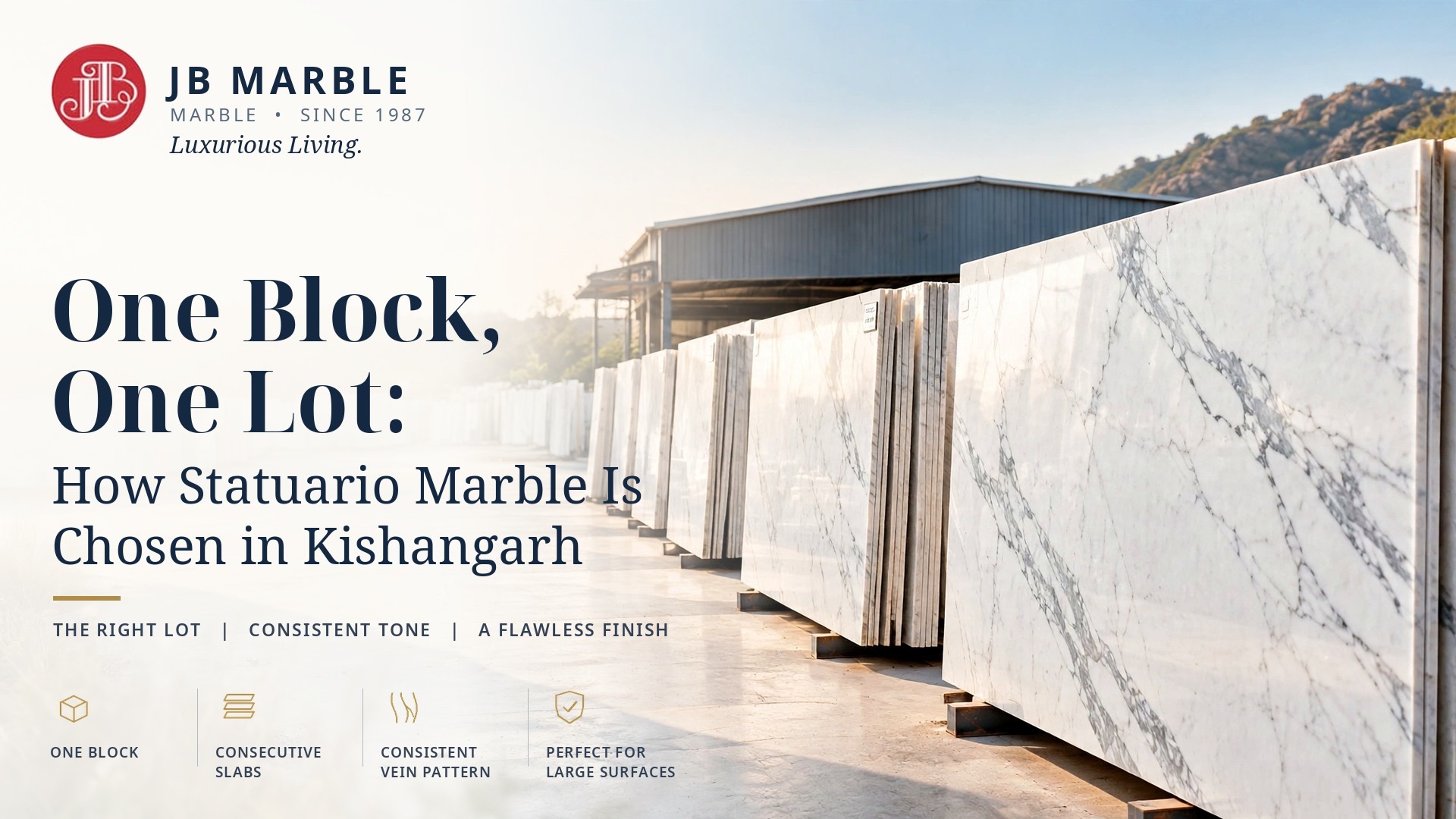
Most buyers walk into the Kishangarh marble market looking for a beautiful slab. Experienced buyers begin with Statuario marble lot selection: they look for a beautiful lot first. A lot is the full set of consecutive slabs cut from a single block of stone, and in the case of Statuario Marble, that distinction decides how a finished floor looks.
Two slabs can both be genuine Statuario, both be polished to the same finish, and still sit awkwardly next to each other because they came from different blocks. This guide explains Statuario marble lot selection in Kishangarh — how it works, why one block keeps a large surface consistent, and how to check a lot before you confirm it.
Quick Answer:
In Kishangarh, plan any large Statuario Marble surface — a floor, a long wall, a staircase — by the lot, not by the individual slab. A lot contains the consecutive slabs sawn from one block, so the background tone and vein family stay related from the first slab to the last. Before confirming, walk the lot in sequence, check the first, middle and last slabs, and reserve enough slabs from the same lot for the full area plus spares. That discipline is the heart of Statuario marble lot selection.
Key Takeaways
- A lot is the set of consecutive slabs cut from one block; the slabs share one background tone and one vein family.
- Floors and large walls expose background differences immediately, so mixed-block material shows patches even when every slab is genuine.
- In Statuario marble lot selection, yards store and display slabs by lot, and slab sequence numbers follow the order in which the block was cut.
- The lot walk — first slab, middle slab, last slab — reveals drift in tone or veining before you commit.
- Always reserve one or two spare slabs from the same lot; a replacement from another block rarely matches.
- Single feature pieces — a table, a small wall, a vanity — are the exception where one chosen slab is enough.
Who This Guide Is For
This guide is written for three readers: homeowners planning a full floor or a large feature wall in Statuario Marble, architects and interior designers specifying the stone across a connected area, and builders sourcing material for villas, hotels and commercial projects. Use this guide at three decision points: when you compare lots in a Kishangarh yard and must judge whether one lot will hold a whole floor, when you decide how many slabs and spares to reserve from a lot, and when you check a lot for the last time before cutting begins — because a lot decision, once cut, cannot be corrected. If your project needs only one statement piece, the closing sections explain when a single slab is the better decision instead. For the wider market, grades and types, see our guide to Statuario Marble in Kishangarh.
1. What Lot Selection Means in the Kishangarh Marble Market
Statuario Marble begins as a large block quarried near Carrara in Italy. In Kishangarh, processing units saw that block into a sequence of slabs, one after another, the way a loaf is sliced. The complete sequence from one block is the lot. Every slab in the lot carries the same mineral background, the same general vein character and the same thickness, because all of them were once a single piece of stone.
Why Yards Sell Sequences, Not Singles
Yards in Kishangarh organise imported marble by lot for a practical reason: serious buyers purchase sequences, not singles. When you ask to see Statuario, the yard will typically walk you to a lot, not to a display wall of unrelated slabs. The slabs stand in cutting order, and the sequence matters. Neighbouring slabs resemble each other most closely, while the first and last slabs of a long lot can differ gently as the block’s interior changes.
For background reading on where this stone comes from, see Carrara marble on Wikipedia — the Apuan Alps quarries above Carrara have supplied statuario-grade white marble since Roman times.
A Lot at a Glance
| Term | What It Means | Why It Matters |
|---|---|---|
| Block | The single large piece of stone quarried in Italy | One block carries one background and one vein family |
| Lot | All slabs sawn consecutively from that block | The unit in which large projects should be selected |
| Sequence | The order in which slabs came off the block | Neighbours match most closely; layout follows this order |
| Background drift | The gentle change in tone across a long lot | Checked before purchase so the floor reads as one surface |
| Spare slabs | Extra slabs reserved from the same lot | Future repairs match instead of standing out |
2. Why One Floor Needs One Block
A floor is the least forgiving surface in a home. Light travels across it, furniture leaves large areas exposed, and the eye compares every square metre with its neighbour. When slabs from two different blocks meet in the middle of a living room, the junction often shows — not as a defect, but as a quiet change in the whiteness of the background or the temperature of the grey in the veins. Each slab is genuine. Together, they read as two floors.
One Background, One Vein Family
Slabs from one lot avoid that break. This is why experienced buyers treat Statuario marble lot selection as a block decision first and a slab decision second. The background stays within one narrow family, so a polished floor reflects light evenly from the entrance to the far wall. The veining also behaves like one drawing rather than several unrelated pictures: bold veins soften, fine veins gather, and the whole surface follows the block’s natural rhythm. For bookmatched features this continuity is essential, and the same principle that governs bookmatched Statuario Marble applies, at a larger scale, to an entire floor.
A Layout the Fabricator Can Plan
There is a second, quieter benefit. When the whole area comes from one lot, the fabricator plans the layout from a known sequence. Vein direction can run consistently across rooms, doorways can carry the pattern through, and the fabricator can place the most expressive slabs where the design wants them — the centre of a hall, the stretch in front of a window — rather than wherever a mismatched slab happens to fit.
3. How a Lot Is Laid Out in a Kishangarh Yard
Statuario marble lot selection starts with understanding the yard’s order — it saves time and prevents a common mistake. Slabs in a lot stand in the sequence in which they were cut, usually on A-frames or in vertical racks, with the polished face of one slab against the back of the next. You cannot judge a lot from the first visible face alone; the yard team will pull slabs forward or turn them as the inspection proceeds.
The Lot Reference Is the Slab's Identity
Most lots carry a painted or stencilled lot reference, and individual slabs follow a sequence order within it. When you shortlist a lot, note that reference and the total slab count. It is your identity record for the material: the same reference should appear on your selection photographs, on the confirmed list, and eventually on the slabs that arrive for fabrication. Photograph the lot reference together with the slabs you approve — that one habit prevents most selection mix-ups between the yard and the site.
How the Lot Is Stored Matters
Finally, check how the yard stores the lot. Slabs should stand evenly supported, without leaning stress, and the edges should be free of fresh chipping from careless handling. A well-kept yard is not a guarantee of quality, but a neglected one adds risk to material that has already travelled a long way.
4. The Lot Walk: Statuario Marble Lot Selection in Practice
A lot can run to many slabs, and no buyer inspects every face with equal attention. The lot walk concentrates on the three slabs that tell the truth about the whole sequence.
First, the first slab
Begin with the opening slab of the lot. It sets the reference: the background tone, the openness of the veins and the overall brightness you are buying. Photograph it in the yard’s natural light, and keep that photograph open on your phone for the rest of the walk.
Then, the middle slab
Move to the centre of the sequence and compare it directly with your photograph. In a sound lot the middle slab feels like a relative — the background sits in the same family and the veining follows the same handwriting. A gentle evolution is normal. A clear jump in tone means the block changed character midway, and a large floor would show that change.
Finally, the last slab
Close with the final slab, because it decides whether the lot can cover your full area with consistency. Check three things:
- Background: compare it against your first-slab photograph.
- Edges: look for damage before you commit.
- Usable size: measure what remains after trimming.
If the last slab still belongs to the family, the lot is coherent — and the slabs between your three checkpoints will follow the same gradual path.
Across all three checkpoints, also confirm thickness from slab to slab and look at the mesh and resin backing that Italian marble commonly carries. The backing should sit evenly, without large loose patches. These are small observations, but they are far easier to make in the yard than after dispatch.
5. How Much Extra to Reserve from the Same Lot
Statuario marble lot selection does not end at the cutting plan. Cutting plans change. A slab can chip during fabrication, a measurement can shift during execution, and a floor laid this year may need one replacement tile-sized section a decade later. Material from another block — even material sold under the same name and grade — will not disappear into the original floor. The background will differ by a shade, and the repair will announce itself every day.
Reserve Spares Before You Need Them
The practical answer is to reserve spare slabs from the same lot at the time of purchase: typically one or two full slabs beyond the cutting plan for a residential floor, held back uncut. Store them flat, protected and clearly marked with the lot reference. This is the cheapest insurance in the entire project, because the alternative — hunting for a matching block years later — almost never succeeds. When you review original Statuario Marble slabs for a project, confirm that the quantity you need, plus spares, exists within one lot before you fall in love with its first slab.
6. When a Single Slab Is Enough
Lot discipline matters where surfaces connect. It matters far less when a piece stands alone:
- A dining table top
- A single vanity counter
- A small pooja background
- One framed wall panel
Each of these can stand alone as an individual slab — in fact, a single expressive slab often serves these pieces better than a quiet sequence would, because the eye reads the whole composition at once.
The dividing line is continuity. If two pieces of stone will touch, align or share one sightline across a room, treat them as one surface and select them from one lot. If a piece stands by itself, choose the single slab whose character suits it best. This one decision — lot for connected surfaces, single for standalone pieces — simplifies most Statuario selections in Kishangarh.
Same Lot or Mixed Slabs: What the Finished Surface Shows
| Decision | On a Large Floor | On a Feature Wall | On a Standalone Piece |
|---|---|---|---|
| One lot, in sequence | One even background; veins flow as a single drawing | Bookmatch and flow stay reliable | Consistent, though more than the piece needs |
| Slabs from different blocks | Visible tone shift where blocks meet | Vein character changes mid-wall | No disadvantage; each piece reads alone |
| One lot plus spares | Repairs vanish into the original surface | A damaged panel can be replaced in family | Spares rarely needed |
7. How JB Marble Handles Lot Selection: Hand-Selected Blocks, Processed In-House
JB Marble does not buy finished Statuario slabs from Kishangarh, or from any other marble market. Our team hand-selects the blocks in Italy, at the source, judging each block’s background and vein character before anyone cuts it. The blocks then travel directly to us, so the marble that reaches Bengaluru has passed through no middleman’s yard and no second selection.
Processed by Our Own Team
We process those blocks ourselves, with modern cutting and polishing technology, and that control is what protects the lot. Because our own team saws the block, the full sequence stays intact:
- We number the slabs as they come off the block.
- We photograph the sequence.
- We check the first, middle and last slabs in open light at our Jigani gallery in Bengaluru.
- We set slabs that drift out of family aside.
- We reserve spare slabs from the same lot for the projects that take it.
For a buyer, the result is a short and visible chain: a block our team chose in Italy, a lot our own processing created in sequence, and the exact slabs you inspect at Jigani before cutting begins. No market handling sits in between.
What Our Own Lot Checks Have Taught Us
In our own lot checking at the Jigani gallery, one pattern repeats. The background tone of a Statuario lot usually holds steady from the first slab to the last; the vein weight is what drifts, growing bolder or quieter towards the end of the block. That is why our team photographs the first, middle and last slabs of every lot in the same light before the lot is offered — a buyer comparing those three frames can see the lot’s full range in a minute, instead of discovering it on the floor. Lots that fail this check are not mixed into other lots; they are set aside for smaller, standalone work.
Frequently Asked Questions
What is a marble lot in Kishangarh?
A marble lot is the complete set of slabs sawn consecutively from one block of stone. All slabs in a lot share the same background tone and vein family, which is why large floors and walls are selected by the lot rather than slab by slab.
Why should Statuario Marble be bought by the lot?
Statuario Marble varies gently from block to block. Slabs from one lot keep one background and one vein character across a whole floor or wall, while slabs mixed from different blocks can show a visible tone change where they meet.
How do I check a Statuario lot before buying?
Use the lot walk: inspect the first slab and photograph it, compare the middle slab against that photograph, then check the last slab for tone, edges and usable size. Also confirm the lot reference, slab count and consistent thickness across the sequence.
Can I buy a single Statuario slab instead of a lot?
Yes, for standalone pieces such as a table top, a vanity counter or a single wall panel, one individually chosen slab is the right approach. Lot selection matters when surfaces connect or share one sightline.
How many spare slabs should I reserve from a lot?
For a residential floor, reserving one or two full slabs beyond the cutting plan is a practical safeguard. Store them uncut and marked with the lot reference, so any future repair matches the original surface.
Does JB Marble sell Statuario Marble by the lot?
Yes. JB Marble hand-selects Statuario blocks in Italy and processes them in-house, so complete lots — the full sequence of slabs from one block — are available for flooring and large installations at the Jigani gallery in Bengaluru. Contact JB Marble to confirm current lot availability for your project.
Choosing the Sequence, Not Just the Slab
Statuario marble lot selection is a sequence decision, not a single-slab decision. A single Statuario slab can be beautiful in isolation and still be the wrong purchase for a connected floor. The block it came from, the company it keeps in the sequence and the spares reserved beside it decide the result as much as the slab itself. When you visit Kishangarh, ask for lots before you ask for slabs — and judge the first, the middle and the last before you judge any one face.
Last updated: 29 October 2026 · JB Marble, Bengaluru
Explore Statuario Marble With JB Marble
JB Marble — Luxurious Living.
From our 2,50,000 sq. ft. gallery and stock yard at Jigani, Bengaluru, we supply original Italian Statuario Marble selected in complete lots for homes and projects across South India. View the actual slabs, walk the sequence with our team, and confirm your selection in person before cutting begins.