

From Quarry Block to Finished Slab: What Actually Happens Inside a Marble Processing Factory?
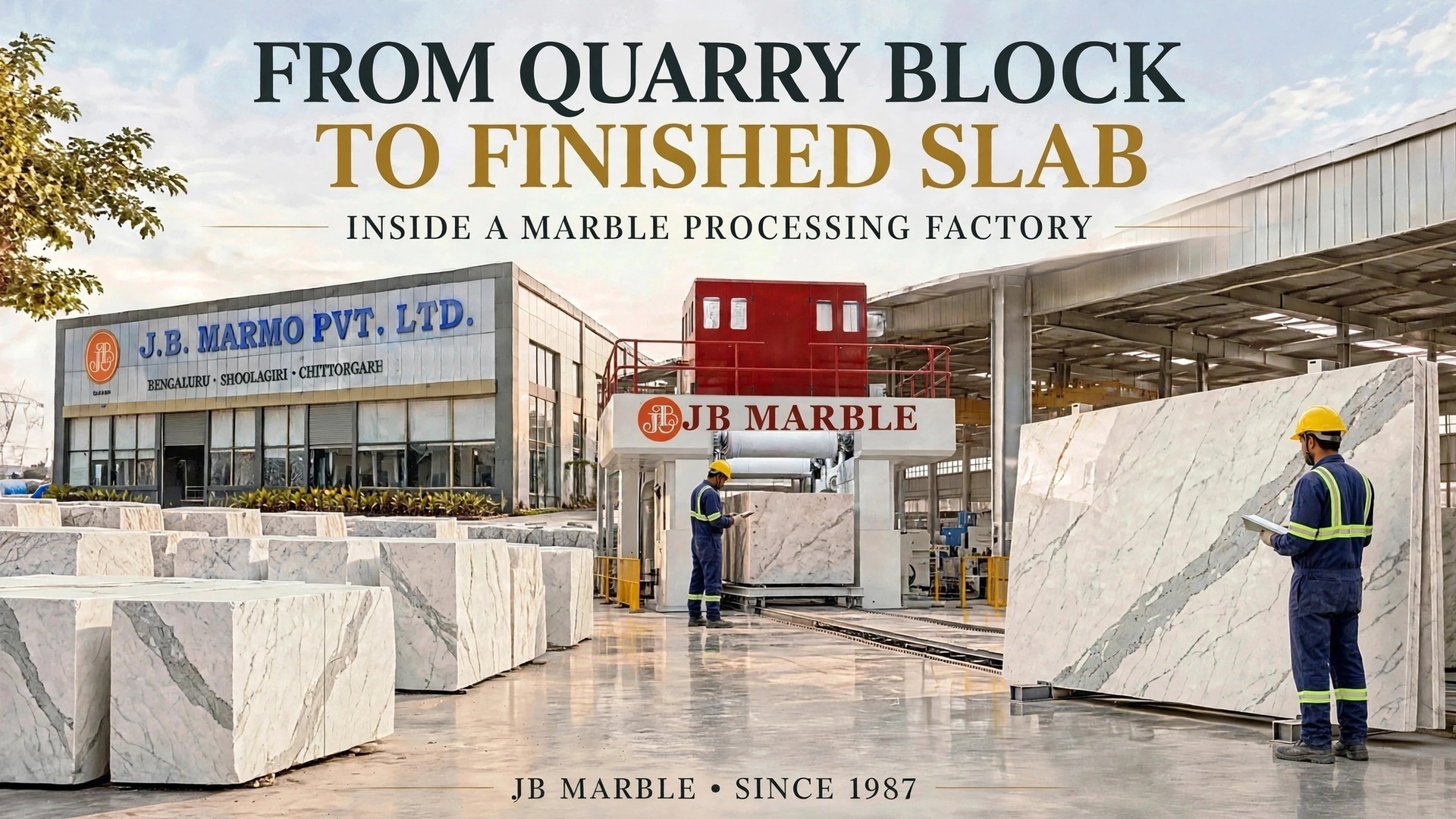
A buyer sees a polished slab standing in a gallery and judges it in seconds. What the buyer cannot see is the week of work that slab has already lived through. A marble processing factory is where a rough quarry block becomes that finished slab, and every stage leaves its mark on the stone. Two factories can start with the same block and deliver visibly different slabs.
In short: a marble processing factory turns a quarry block into finished slabs through seven stations: block inspection, the cutting plan, wire sawing, resin and reinforcement, polishing, hand finishing, and sorting into lots. The quality of the finished slab is decided at these stations, not in the showroom.
This guide follows one block through all seven stations: what happens at each stage, what each stage decides, and what buyers should understand before approving material.
Quick Answer:
The short answer is this: inside a marble processing factory, a block is first inspected and read, then sawn into raw slabs, dried and strengthened with resin and mesh, polished on a line, finished and repaired by hand where needed, and finally sorted into lots and inspected slab by slab. Nothing in this chain is decorative. Each station either protects the stone’s natural character or damages it, and the finished slab carries the record of every decision.
At JB Marble, the blocks our own team hand-selects at quarries around the world come directly to our factory at Shoolagiri Hosur, Tamil Nadu, and pass through every one of these stations in-house, so the lot a buyer approves is the lot our factory produced.
Key Takeaways
- A finished slab is the product of seven factory stations, and weakness at any one station shows in the final surface.
- The cutting plan, made before the first cut, decides how the block's veining will appear across every slab.
- Resin and reinforcement are structural stages, not cosmetic cover-ups, when they are done at the right time and in the right order.
- Hand finishing still matters in a modern factory, because machines cannot judge a fissure or an edge the way a trained hand can.
- Sorting into lots at the end is what guarantees that the slabs a buyer approves are the slabs the project receives.
Who This Guide Is For
Audience: Homeowners planning marble flooring or wall cladding, architects and interior designers who specify natural stone, and project buyers who approve slabs before fabrication.
Use cases: Understanding why two slabs of the same stone can differ in finish and strength, preparing questions to ask a supplier about processing, and knowing what to look for during a factory or yard visit.
Decision context: Read this before you approve a lot or release an advance, so your decision rests on how the material was processed, not only on how one polished slab looked under showroom light.
1. Station One: The Block Arrives and Is Read
The journey begins in the block yard. A block is a large rectangular piece of stone cut from the quarry bench, and it arrives with its history written on its surface. Before anything else happens in a marble processing factory, the block is washed, inspected and read.
Reading a block is a skill. The team studies the visible veins on its faces, taps for hollow sounds that suggest internal fractures, and checks the corners and edges for damage from transport. This first reading decides whether the block is sound enough for full slabs at all.
The block receives its identity
Every block also receives its identity at this station. Its source, arrival date and inspection notes are recorded, and that identity follows its slabs through the factory. This record is what later allows a finished lot to be traced back to one block. Marble itself is a metamorphic rock formed under heat and pressure, which is why no two blocks ever carry the same internal pattern.
2. Station Two: The Cutting Plan
Before the saw touches stone, the factory makes the most creative decision of the whole process: how the block will be opened. A block can be sawn in more than one direction, and each direction shows a different face of the same stone.
Sawing along the vein produces long, flowing movement across the slab. Sawing across the vein produces a quieter, cloud-like pattern. Neither is wrong, but they suit different projects, and once the first cut is made the decision cannot be reversed.
Thickness is fixed before the first cut
The cutting plan also fixes the slab thickness for the batch, most commonly 18 mm or 20 mm for flooring and cladding slabs. Thickness is not a minor setting. It affects the slab’s strength, its weight on the floor, and how it can be handled and installed later.
A careful factory plans the cut around the block’s own character. A careless one cuts every block the same way and lets the pattern fall where it falls. The difference is visible in every slab that follows.
3. Station Three: Wire Sawing, From Block to Raw Slabs
With the plan fixed, the block moves to the saws. Modern factories cut marble with thin wire saws, where a wire carrying industrial diamond beads runs continuously through the stone, cooled by water. The wire saw cuts with far less vibration and a narrower cut than older frame saws.
That gentleness matters. Marble is a relatively soft, crystalline stone, and violent cutting can open micro-fractures that only appear later, during polishing or even after installation. A clean wire cut keeps the slab’s internal structure quiet.
Slabs are kept in sequence
As each slab comes off the block, it is kept in sequence. Slabs are not mixed with slabs from other blocks, because sequence is what makes bookmatching and lot consistency possible later. At this point the slabs are still raw: rough-surfaced, dull and fragile at their edges.
The operator’s patience decides a great deal here. Feeding the wire too fast saves hours and costs quality, raising the risk of wavy surfaces and cracked corners that no amount of polishing can fully hide.
4. Station Four: Drying, Resin and Reinforcement
Raw slabs hold water from the sawing, and they must dry before the next stage. Rushing a wet slab into treatment traps moisture inside, so the factory gives the slabs time and airflow first. This quiet waiting stage protects everything that follows.
Once dry, the slab’s face is treated with resin. The resin flows into the stone’s natural pores, fine fissures and pinholes, then hardens. Done correctly, this is a structural treatment: it binds the surface, reduces the risk of cracks opening during handling, and prepares the face for an even polish.
Many slabs also receive reinforcement on the back, where a mesh is fixed with resin to hold the slab together across its weakest lines. Some factories add a vacuum stage, drawing the resin deeper into the stone under pressure. At JB Marble, a robotic vacuum reinforcement system performs this stage in-house.
The order of stages matters
The order matters as much as the materials. Resin before drying fails. Polish before resin wastes the treatment. A marble processing factory earns its reputation in these unglamorous sequences that a buyer never sees.
5. Station Five: The Polishing Line
Polishing is the stage buyers imagine first, and it is where the stone’s colour finally appears. The slab travels along a line of rotating heads fitted with abrasives of increasing fineness. Each head removes the marks of the one before it.
Early heads level the surface and close the saw marks. Middle heads refine the texture and begin to build the sheen. Final heads bring the polish the stone is known for, deepening the ground colour and sharpening every vein.
Every stone takes a different setting
The line must be set for the stone in front of it. A hard, dense marble and a softer, more delicate one do not take the same pressure or the same sequence. An operator who treats every stone identically will under-polish one lot and burn the surface of another.
Finish is also decided here. The same line, stopped earlier and finished differently, produces a honed surface with a soft, low sheen instead of a full polish. This is why two lots compared in different finishes can look like different stones.
6. Station Six: Hand Finishing and Honest Repair
Machines polish faces. They do not finish a slab. Edges, corners and local defects still pass through human hands, and in our factory eight hand polishing units handle this work after the line.
A trained finisher reads a slab the way the block reader read the block. A natural fissure that follows the stone’s grain may be perfectly sound. A crack that cuts across it is a weakness. The finisher’s judgement decides what is repaired, what is accepted, and what is rejected.
The limits of honest repair
Honest repair has limits, and a good factory states them plainly. Resin can fill a pinhole. It cannot turn a structurally weak slab into a strong one, and no repair should be hidden from the buyer who will live with the stone.
Slabs that fail at this station do not move forward quietly. They are separated from the lot, because one weak slab hidden inside a good lot damages trust in the whole delivery.
7. Station Seven: Sorting Into Lots and Final Inspection
The last station decides what the buyer actually receives. Finished slabs are inspected one by one under strong, even light, then sorted by ground colour, vein character and finish into lots. A lot is the slabs of one block, or of closely matching blocks, kept together.
This sorting is the factory’s promise. When a buyer approves a lot at JB Marble, the approval attaches to those exact slabs, identified and kept together from this station to dispatch. Our marble lot selection guide explains how that approval works from the buyer’s side.
The final check before a lot is released
Final inspection also confirms the practical details: thickness across the slab, edge condition, surface consistency and the slab count against the lot record. Only after this check does a lot become available for a project.
What happens between two lots of the same stone is explained in our guide to why two marble lots differ. The short version is that sorting can manage variation honestly, but no factory can erase it, and none should promise to.
Inside Our Own Factory at Shoolagiri, Hosur
This process is our daily work, not a description we borrowed. JB Marble’s factory at Shoolagiri, Hosur runs four thin wire saw machines, three resin plants, three line polishing machines and eight hand polishing units, with a robotic vacuum reinforcement system for the slabs that need deeper strengthening.
Our blocks do not come from any market. Our own team travels to the source quarries — in Italy, Greece, Vietnam and other marble regions of the world — selects blocks there and imports them directly, and every station described in this guide happens under our own roof. That single chain of custody is why we can tell a buyer exactly how their lot was processed.
Buyers can walk the process with us
When a buyer visits, we do not only show finished slabs. We walk them past the block yard, the saws and the polishing line, because a buyer who has seen the process asks better questions and approves with more confidence. You can plan such a visit through our contact page.
One Block's Journey: What Each Station Decides
| Station | What happens | What it decides |
|---|---|---|
| Block reading | Washed, inspected, recorded | Whether the block is sound enough for full slabs |
| Cutting plan | Direction and thickness fixed | How the veining will appear on every slab |
| Wire sawing | Block cut into sequenced raw slabs | Surface accuracy and internal calm of the slab |
| Resin and reinforcement | Dried, resin-treated, mesh-backed | Strength for handling, transport and installation |
| Polishing line | Abrasive heads of increasing fineness | Final colour depth, sheen and finish |
| Hand finishing | Edges finished, defects judged | Which slabs are accepted, repaired or rejected |
| Sorting and inspection | Slabs grouped into lots, checked one by one | That the approved lot is the delivered lot |
Why the earliest station matters most
Read the table as the block experiences it. A weakness accepted at any early station is carried into every later one, and the final inspection can only reject it, not undo it. That is why the factory, not the showroom, is where slab quality is truly made.
What a Buyer Should Take From All This
For an architect, the lesson is specification. A specification that names a stone but says nothing about processing leaves the most important decisions to chance. Naming the finish, the thickness and the lot approval stage gives the factory clear duties and the project a clear record.
For a homeowner, the lesson is simpler. The polished slab in front of you is evidence of a process, and it is fair to ask about that process. Which factory processed it, how was it reinforced, and can you approve the full lot are reasonable questions, not difficult ones.
For a project buyer, the lesson is sequence. Approve finished lots, not raw promises, and let the factory’s sorting work for you. Our Statuario marble slabs page shows what a fully processed, lot-approved Italian marble looks like at the end of this journey.
Frequently Asked Questions
How long does it take to process one marble block into finished slabs?
A single block typically takes several days from first cut to final inspection. Sawing alone can run for many hours, and drying, resin curing and polishing each add their own time. Rushing any of these stages risks cracks, trapped moisture or an uneven polish, so a careful marble processing factory protects the sequence instead of compressing it.
Why do factories use resin on marble slabs?
Factories use resin to strengthen the slab, not to disguise it. The resin fills natural pores, pinholes and fine fissures, binds the surface and helps the slab survive handling, transport and installation. Combined with mesh reinforcement on the back, it supports the stone across its weakest lines while leaving the face and pattern entirely natural.
What is the difference between a wire saw and a gangsaw for marble?
A wire saw cuts with a continuous wire carrying diamond beads, producing a narrow cut with very little vibration. A gangsaw cuts with many straight blades moving together, which suits some stones but shakes the block more. For delicate natural marble, the gentler wire cut lowers the risk of micro-fractures that can appear later as cracks.
Does polishing change the colour of a marble slab?
Yes, polishing changes how the colour reads. A polished finish deepens the ground colour and sharpens the veining, while a honed finish softens both. The stone itself does not change. This is why lots should always be compared in the same finish and under the same light before approval.
Can a buyer visit the factory before approving slabs?
Yes, and a serious buyer should. A factory visit shows the block yard, the cutting and polishing lines and the sorting racks, which no brochure can reproduce. At JB Marble, buyers can walk the Shoolagiri factory and then approve the actual finished lot their project will receive, in full slabs, before ordering.
Why are slabs sorted into lots after processing?
Slabs are sorted into lots so that one project receives material with a consistent ground colour and vein character. Even slabs from a single quarry vary from block to block. Keeping each block’s slabs together as one lot, and letting the buyer approve that exact lot, is how a factory manages natural variation honestly.
Last updated: 15 November 2026 · JB Marble, Bengaluru
See the Process at JB Marble
JB Marble — Luxurious Living.
A slab makes more sense after you have seen how it was made. Visit the JB Marble factory and gallery at Jigani, Bengaluru, walk the process from block yard to polishing line, and then approve your lot with the full picture in mind.