

Not Veins, But Fragments: Reading the Natural Structure of Breccia Marble
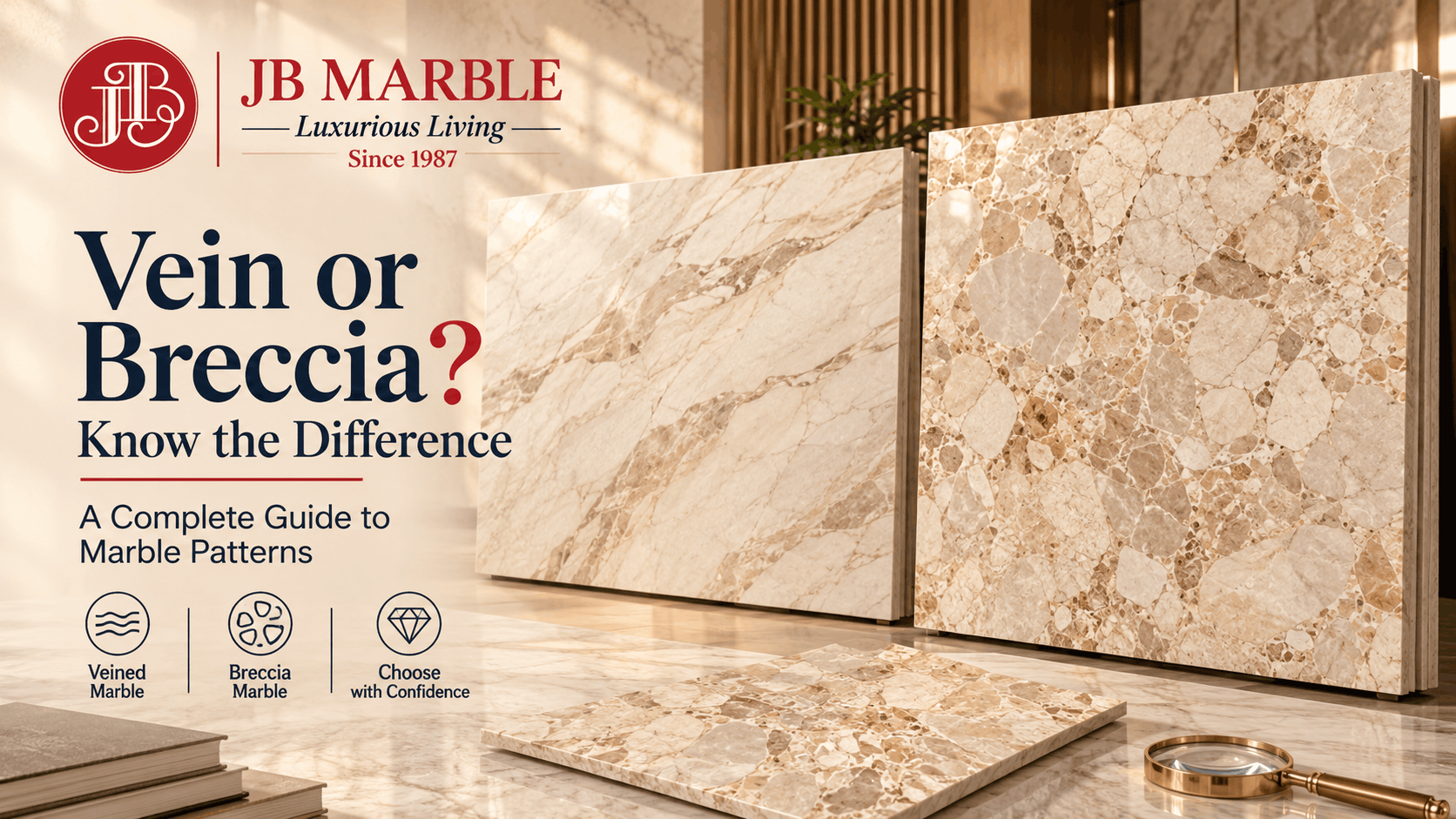
Most marble reads as a pattern of lines. Grey veins cross a white ground, and the eye follows them the way it follows handwriting. Breccia marble refuses that reading entirely, because breccia marble structure is built from pieces, not lines. Angular fragments sit side by side inside a mineral cement, each keeping its own colour, edges and direction. This guide teaches you to read that structure, using Breccia Aurora, the warm Italian stone at JB Marble, as its working example.
In short: a vein is one continuous mineral line, while a fragment is a complete piece of stone. Veined marble flows, whereas breccia marble assembles. Once you see the difference, you will read every slab differently.
Breccia Aurora comes from the Brescia basin in Lombardy, northern Italy. Typically, its ground is cream-beige, its larger pieces run brown and rust-brown, and fine white crackle lines stitch the whole surface. Geologists classify the stone as a limestone breccia, although the trade sells it as marble because it takes a marble polish. The official Lombardy stone register likewise records Breccia Aurora as a limestone breccia of calcium carbonate, quarried at Gavardo and Paitone. That double identity, in fact, is exactly why it teaches the lesson so well.
At our Jigani gallery, buyers compare this stone with a veined white marble and ask why they feel so different. The answer is structural, not decorative: one stone was drawn in lines, the other assembled from pieces.
Quick Answer:
The short answer is this: veined marble carries its pattern in continuous mineral lines that flow across the slab. Breccia marble carries its pattern in separate angular fragments, called clasts, locked inside a natural cement. So a vein tells you where mineral water once flowed, while a fragment tells you where solid stone once stood. Reading breccia marble structure therefore means reading pieces, boundaries and cement — never lines.
Key Takeaways
- A vein is a filled line; a fragment is a whole piece of stone with edges of its own.
- Breccia structure has three parts: clasts, cement and the boundaries between them.
- Sharp fragment edges mean the pieces barely travelled before they were locked in place.
- Cement colour records a second mineral event, later than the fragments themselves.
- Veined lots are approved for flow and direction; breccia lots are approved for fragment balance and scale.
Who This Guide Is For
Audience: homeowners choosing between a veined marble and Breccia Aurora, architects specifying a fragmented Italian stone, and buyers comparing breccia lots before booking.
Use cases: use it when you compare two pattern types for one room, judge a full slab at the gallery, or brief your architect on the look you actually want.
Decision context: read it before you approve a slab or confirm a lot, because the structure you choose decides how the finished room will read — flowing or assembled.
1. The Two Grammars of Stone
Every patterned stone speaks one of two grammars. Veined marble speaks in lines, while breccia speaks in pieces. A vein begins as a fine fracture that mineral water later fills, so the finished line stays continuous from edge to edge. You can trace a single vein across a whole slab without lifting your eye. Geologists describe exactly this process in how mineral veins form inside rock.
A fragment behaves in the opposite way. It is a complete piece of stone with a beginning and an end, and it points wherever it settled. Consequently, the eye does not travel across a breccia slab; instead, it rests on one piece, then steps to the next. A veined floor feels like a river system, whereas a breccia floor feels like a stone pavement that geology laid itself.
Lines That Flow, Pieces That Sit
This difference changes how a room feels. Veined marble brings movement, so it suits rooms that want energy and direction. Breccia brings assembly, so it suits rooms that want weight and calm. Neither grammar is better than the other. However, they fail differently, they photograph differently, and they must be approved differently — which is why confusing them leads to wrong selections.
2. Anatomy of a Fragmented Pattern
Breccia marble structure rests on three parts, and each part has a separate job. The clast is the fragment itself, and it carries the colour and texture of the original stone. Next comes the cement, the mineral — usually calcite — that later filled the gaps and hardened around the pieces. The boundary is the edge where a piece meets the cement, and it decides how crisp the whole pattern reads. Even the geological definition of breccia rests on exactly these parts: angular clasts, held in a finer mineral ground.
Clast, Cement, Boundary
Read any breccia slab in that order and the surface stops looking random. First, read the clasts and note their colours and sizes. Next, read the cement and note its tone and width. Finally, read the boundaries and judge whether they are sharp or soft. Sharp boundaries give a graphic, architectural surface. Softer boundaries give a quieter, blended one. Breccia Aurora, notably, keeps its boundaries sharp, which is why its pattern reads so clearly from across a room.
3. Vein Against Fragment: The Full Comparison
The table below sets the two grammars side by side. It is the quickest way to see why a selection method that works for veined marble fails for breccia.
| Feature | Veined Marble | Breccia Marble |
|---|---|---|
| Pattern unit | A continuous mineral line | A complete fragment of stone |
| Eye movement | Follows the line across the slab | Rests on each piece, then steps to the next |
| Direction | Strong — the veins run somewhere | None — the pieces face every way |
| Repetition | Veins can echo each other in a rhythm | No two fragments ever repeat |
| Small sample | Represents the slab fairly | Shows one fragment only — and misleads |
| Bookmatched pair | Mirrors into flowing symmetry | Mirrors into a kaleidoscope composition |
| Selection focus | Flow and direction | Fragment balance and scale |
Three rows matter most at selection time. First, direction: veins run somewhere, so their direction must be planned. Fragments face every way, so no such planning exists. Second, the sample row: a veined sample represents its slab fairly, while a breccia sample shows a single fragment and misleads. Third, repetition: veins can echo each other in a rhythm, whereas no two fragments ever repeat. Together, these three rows explain most disappointed selections we see.
4. One Stone or Many: Reading the Mix
Some breccias are built from one stone only, and geologists call them monomict. Others mix several stones together, and those are polymict. The distinction sounds academic, yet it decides the colour discipline of your slab. A monomict breccia stays inside one colour family, so the surface feels composed. A polymict breccia brings contrasting stones together, so the surface feels energetic and busy.
Monomict and Polymict Breccias
Breccia Aurora sits close to the monomict end. Its fragments all come from one limestone family, so cream, beige, brown and rust read as relatives, not rivals. The variety is real, but it stays inside a warm tonal range. When you read a new breccia lot, therefore, count its colour families before you judge its beauty. One family usually means a calmer room. Three or more families mean the stone will dominate every other material near it.
5. The Cement Is the Second Story
Every breccia carries two events inside it. It began as one unbroken limestone layer. Its fragments record the first event, when solid limestone fractured where it stood. The cement records the second event, when mineral water arrived later and hardened between the pieces. Because the cement is younger than the fragments, its colour often differs from theirs. That contrast, in fact, is what makes the structure visible at all.
White Crackle, Iron Tints and Quiet Grey
Cement speaks in a few tones. White calcite cement draws fine crackle lines, so the slab gains detail that rewards close viewing. Iron-tinted cement warms the gaps and deepens the rust family. Grey cement stays quiet, so the fragments carry the whole composition alone. Width matters as much as colour: hairline cement keeps the stone calm at distance, while broad cement bands turn the surface graphic. In Breccia Aurora, the cement is mostly fine and white. Consequently, the stone reads warm and composed from across a room, then richly detailed when you stand close.
Light changes the verdict, too. Side light rakes across the surface and deepens every cement seam, so the fragmented pattern looks bold and dramatic. Front light falls flat and softens the same seams, so the stone reads quieter and warmer. Judge your slab, therefore, in light that resembles the room it will live in, because a gallery’s bright front light flatters every breccia into calmness.
6. Reading Breccia Aurora, Piece by Piece
Theory becomes useful only on a real slab, so here breccia marble structure gets read on the stone itself. Take one Breccia Aurora slab at full size and read it in the order this guide has built: pieces first, cement second, boundaries last. The table below is that reading, worked on the stone itself.
| What You See | What It Is | What It Tells You |
|---|---|---|
| Cream-beige pieces | Limestone clasts | The original stone, in its calmest tone |
| Brown and rust-brown bands | Iron-rich fragment zones | Mineral variation inside the source bed |
| Fine white crackle lines | Later calcite cement | The second event that locked the pieces together |
| Sharp, angular edges | Fragments that barely moved | The stone fractured where it stood |
| Pieces of many sizes | Mixed fragment scale | A natural composition that cannot repeat |
Notice what this reading gives you. You now know which tones belong to the original limestone and which tones arrived later with the cement. You also know why the edges stay sharp: the fragments barely moved before the cement locked them. A buyer who reads this way stops asking whether the pattern is printed or painted. The structure itself answers, because no printing process invents boundaries this honest.
7. Count the Boundaries, Then Approve the Stone
Reading skill becomes useful only when it turns into a decision. At the gallery, that decision happens in two movements: first you measure the stone, then you judge how it will live in your room. Both movements happen at the full slab, on the actual lot you are considering.
First, Count the Boundaries
Stand before any breccia slab and run this simple test. Choose one straight stretch of the surface, roughly a metre long, at eye level. Then count how many fragment boundaries that line crosses. Each crossing marks the place where one piece ends and another begins. On a veined marble, the same line crosses only a few veins. On Breccia Aurora, it crosses boundary after boundary, because the surface is built from pieces.
The count turns scale into a number. A high count means fine fragments, so the slab rewards close viewing in smaller rooms. A low count means large pieces, so the slab needs distance to compose. The test also separates one block from another honestly: count a slab from a second block and the number changes, because every block carries its own fragment scale. Choose the block whose count suits your room, then approve that block’s bookmatched pairs as your lot.
Then, Judge the Pair at Two Distances
Counting settles the scale; it does not settle the feeling. So step back and read the bookmatched pair together, exactly as the wall will show it. Take in the warm balance of the large pieces, and the rust bands sitting where the composition needs weight. Then step close, to arm’s length, and read the detail at that range. The fine white crackle, the sharpness of the boundaries, the polish carrying evenly across clast and cement — this is what the room’s occupants will live with. A pair that satisfies at both distances is the right approval. A feature wall, after all, is judged from the doorway and from the sofa alike. Our team walks buyers through both movements at the gallery, on the actual Breccia Aurora Marble lots in stock.
Frequently Asked Questions
What is the difference between a vein and a fragment in marble?
A vein is a continuous mineral line that formed when mineral water filled a fine fracture and hardened. A fragment is a complete piece of stone with its own edges, colour and direction. Veins flow across a slab without stopping, while fragments sit as separate pieces inside a cement. That is why veined marble reads as movement and breccia reads as assembly.
What are clasts and cement in breccia marble?
Clasts are the angular fragments themselves, and each one carries the colour of the original stone. Cement is the younger mineral, usually calcite, that later filled the gaps between the fragments and hardened around them. Together with the boundaries where piece meets cement, they form the complete breccia marble structure. Reading a breccia means reading all three parts in that order.
Is Breccia Aurora a veined marble?
No. Breccia Aurora is a brecciated stone, not a veined one. Its pattern is built from angular limestone fragments in cream, beige, brown and rust tones, stitched together by fine white calcite cement. The white crackle lines can look like veins at a glance, but they are cement seams between pieces, not flowing mineral veins. At full slab, the difference is unmistakable.
Why does breccia marble change from block to block?
Because every block is a separate body of stone, cut from a different part of the quarry. The fragments inside one block formed together, so their colours and sizes belong to one family. Another block, even from the same quarry bench, carries its own fragment mix and its own balance. That is why a lot is always approved as one block’s slabs, never from a photograph of a different block. Within your block, the slabs come as bookmatched pairs, so the composition you approve is the composition you receive.
Does a small sample show breccia marble structure honestly?
Rarely. A small sample usually lands on a single fragment, so it shows one colour and none of the structure. It cannot show the cement network, the fragment scale or the balance of the full slab. A veined marble sample misleads far less, because one line represents the whole pattern fairly. Breccia, by contrast, must be approved at full slab and across the full lot.
How should I judge a breccia marble lot before booking?
Judge the lot in three passes at the gallery. First, check the fragment scale against the size of your room. Second, judge the cement contrast, because it decides whether the surface reads graphic or calm. Third, view the bookmatched pairs together, so you approve the exact composition that will appear on your wall. Reserve your lot only after all three passes satisfy you.
Read the Stone You Are Buying
A vein asks to be followed. A fragment asks to be read. Once you know that breccia marble structure is built from pieces, cement and boundaries, the surface stops being a mystery and becomes a document you can judge with confidence. Breccia Aurora rewards that reading more than most stones, because its warm fragments and fine white cement keep the whole story visible at full slab. Visit our Jigani gallery, stand before the complete lot, and read the stone the way it was written — piece by piece.
Last updated: 17 November 2026 · JB Marble, Bengaluru
Looking for Breccia Aurora in Bangalore?
JB Marble — Luxurious Living.
See complete Breccia Aurora lots at our 250,000-square-foot luxury marble gallery at Jigani, Bengaluru — read the full sequence in person, with our team beside you.