

Beyond the White Surface: What Makes Statuario Marble a Statement in Luxury Architecture
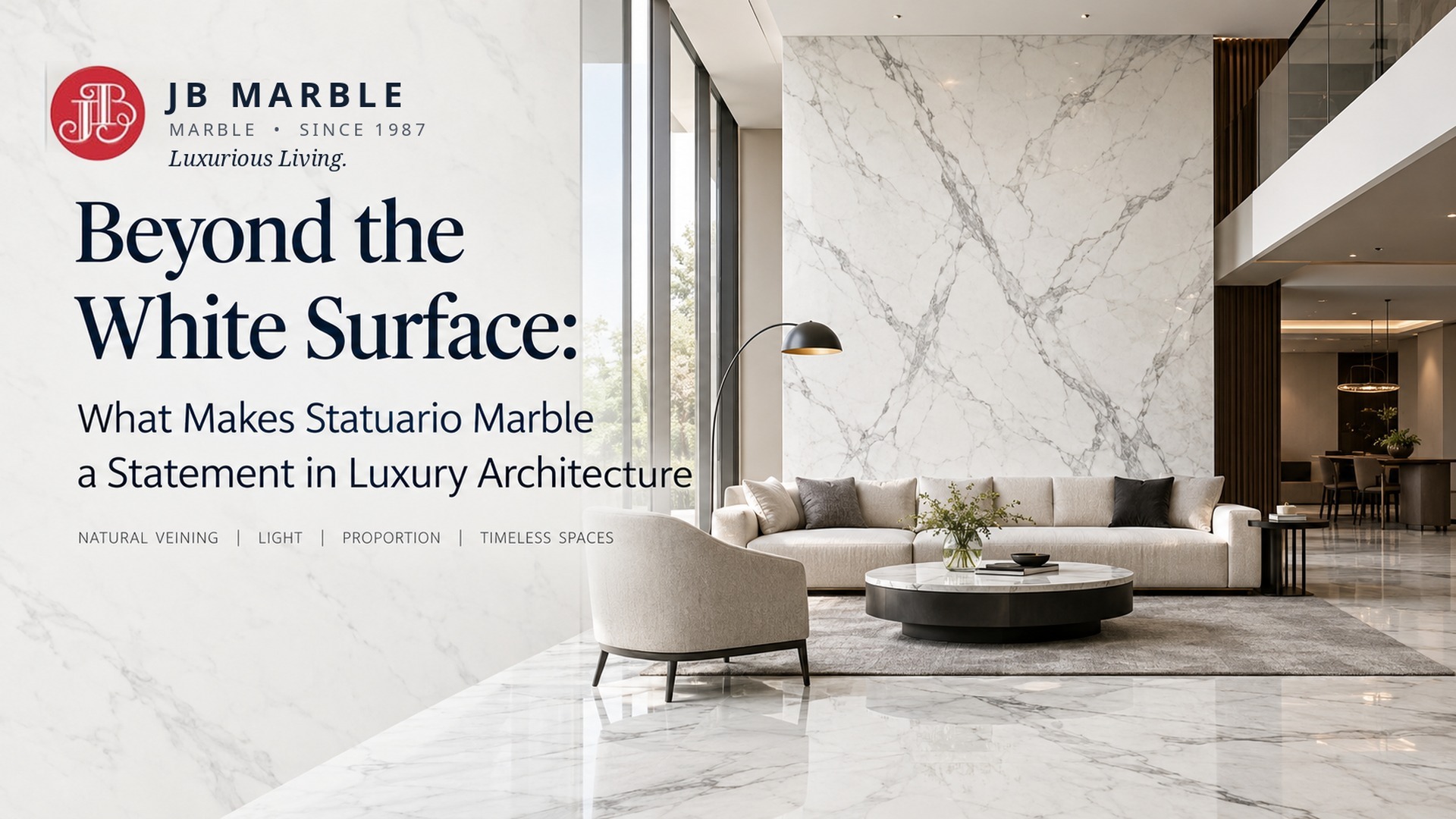
In Short
Quick Answer: Statuario Marble makes a statement in luxury architecture through its luminous white background, naturally expressive grey veining, and ability to become an integral part of an interior’s design. Rather than serving as a neutral finishing material, it can influence how a room feels, how light interacts with surfaces, and where the eye naturally settles. Its impact depends on the individual slab, architectural proportions, lighting, and the way specialists select and install the stone.
Key Takeaways
- Statuario Marble is a premium white marble from Carrara, Tuscany, with a bright white background and naturally expressive grey veining.
- Its veining is a design element, not a pattern — direction, strength, and layout decide whether a room gains a focal point or a distraction.
- Light and finish change the stone’s character, so the actual slab should be reviewed under lighting similar to the finished space.
- Bookmatched pairs can form a symmetrical composition, but only when the slabs are true neighbours and the layout is planned before fabrication.
- The actual slab, not a catalogue photograph, decides the result — background, vein direction, dimensions, and finish must be checked on the material itself.
A single material rarely defines luxury architecture. It emerges from the relationship between space, light, proportion, texture, and craftsmanship. Yet some materials have the ability to bring these elements together. Statuario Marble is one such material, valued for the contrast between its white background and distinctive grey veins.
In a thoughtfully designed interior, this contrast can become more than a decorative feature. It can guide the composition of a room, establish a focal point, and connect different architectural elements through a consistent material language.
For architects, interior designers, and homeowners planning premium spaces, understanding Statuario Marble means looking beyond its colour. The real design opportunity lies in how the stone is chosen, positioned, and integrated into the architecture.
Who This Guide Is For
This guide is for architects, interior designers, and homeowners who are planning a premium interior and want to judge Statuario Marble as an architectural material, not just a colour. Read it before you shortlist slabs, because the decisions below — vein character, light, proportion, and selection — are easiest to make before cutting begins. To see the material itself, explore Statuario Marble slabs, specifications and selection at JB Marble.
1. Why Statuario Marble Is More Than a White Surface
Designers often select white marble to create brightness, visual continuity, and a sense of openness. However, not every white marble creates the same impression.
Statuario Marble is known for its white to bright-white background and naturally occurring grey veining. Depending on the individual slab, these veins may appear as fine lines, sweeping movements, or stronger contrasting patterns.
This natural variation gives the material a distinctive visual identity. The background provides a relatively light visual field, while the veining introduces movement and definition.
In architectural design, that combination can serve several purposes:
- Establishing a focal point without relying on elaborate decoration.
- Connecting white, grey, timber, and metallic finishes within a coordinated palette.
- Creating visual continuity across selected floors, walls, and architectural details.
- Introducing natural variation into interiors built around clean lines and simple forms.
The important distinction is that Statuario Marble does not have a uniform printed pattern. Each slab has its own appearance, so the finished design depends on the actual material selected for the project.
2. The Italian Marble Heritage Behind Statuario
Statuario is associated with the marble-producing region around Carrara in Tuscany, Italy, particularly the Apuan Alps. The area has a long history of supplying marble for sculpture and architecture.
The material’s historical significance is closely connected to its use in sculptural work. Sculptors have valued fine-grained white marble because it can support detailed shaping and refined surface finishes.
Today, Statuario Marble is also considered for contemporary architectural interiors, where its natural veining provides a different kind of expression. Instead of being shaped into a sculpture, the stone itself can become part of the architectural composition.
However, buyers should not treat the name alone as proof of a particular slab’s origin or grade. Buyers should confirm the stated origin and material details with their supplier, especially when comparing premium marble quotations.
For a modern project, the value of Statuario lies in combining its natural character with a clear architectural purpose rather than relying on its heritage alone.
Statuario at a Glance
| Origin | Carrara, Tuscany, Italy (Apuan Alps) |
| Material | Calcite-based natural marble |
| Background | White to bright white |
| Veining | Natural grey — fine lines to strong, sweeping movements |
| Slab size | Gangsaw slabs |
| Thickness at JB Marble | 18 mm and 20 mm |
| Finishes | Polished; honed on request |
| Design role | Statement surfaces and bookmatched compositions |
3. Natural Veining as an Architectural Design Element
Answer: One of the most important decisions when specifying Statuario Marble is how to work with its natural veining.
Unlike a repetitive surface pattern, natural veins do not follow a designer’s predetermined arrangement. They may travel diagonally across a slab, form broad movements, or create areas of contrast against the white background.
Instead of treating this variation as something to hide, designers can use it to guide the visual composition.
Fine and restrained veining
Slabs with relatively subtle patterns can suit interiors where continuity and simplicity are important. They may work well across selected flooring areas, understated wall panels, and spaces with several other materials.
Strong, expressive veining
More prominent patterns can provide a focal point in an entrance, living room, reception area, or feature wall. In these applications, furniture and surrounding finishes can remain relatively restrained so the natural stone retains its visual importance.
Bookmatched compositions
Bookmatching involves positioning adjacent slabs so their vein patterns mirror one another. When the natural patterns allow it, this technique can create a symmetrical composition across a large wall or other prominent surface.
The effect depends on the actual slabs, cutting sequence, and layout. Not every slab pair will create a balanced mirror image, which is why reviewing the material before fabrication is essential.
The goal is not simply to choose the most dramatic slab. It is to choose a pattern that suits the dimensions, function, and character of the space.
See how bookmatched Statuario marble turns one wall into the axis of a space.
Choosing the Vein Character
| Vein character | Design role | Keep in mind |
|---|---|---|
| Fine and restrained | Continuity across floors and understated wall panels | Judge it at full-slab scale — a subtle pattern can disappear in a large room |
| Strong and expressive | A focal point for entrances, living rooms, and feature walls | Keep furniture and surrounding finishes restrained |
| Bookmatched pair | A symmetrical artwork at architectural scale | The slabs must be true neighbours, and the layout must be planned before cutting |
4. How Light Changes the Experience of Statuario Marble
Answer: Light can significantly influence how viewers perceive a marble surface. Daylight, artificial illumination, surface finish, and viewing angle all affect the appearance of the white background and grey veining.
In a room with generous natural light, Statuario Marble may appear visually bright and clearly defined. In a space with softer illumination, its pattern may feel more subdued.
The Four Most Requested Architectural Proportions
Artificial lighting introduces another layer of control. Wall washers can emphasise the movement of veins across a feature wall, while concealed lighting may highlight selected architectural details.
However, the lighting design should follow the actual slab and its finish. A reflective polished surface can produce glare when luminaires are positioned poorly.
Before finalising the design, review the stone under lighting conditions similar to those expected in the completed space. This helps establish whether the veining, colour contrast, and reflections work with the intended atmosphere.
5. Using Statuario Marble to Define Architectural Proportions
Answer: A material can influence how a space is visually organised. The scale of the slab pattern, direction of the veins, size of the installation, and placement of joints all contribute to the final impression.
The Four Most Requested Architectural Proportions
Large living rooms and open-plan interiors
In an open-plan space, carefully laid marble flooring can help connect the living, dining, and circulation areas. The layout should account for natural pattern variation and transitions to other flooring materials.Double-height walls
A tall feature wall offers an opportunity to display the movement of natural veining over a larger surface. Plan panel proportions, joints, lighting, and viewing distance together.Entrance foyers
An entrance can benefit from a clearly defined focal element. A marble floor or feature panel may establish the material palette for the rest of the interior without requiring the same stone everywhere.Staircases
Statuario Marble can be considered for treads, risers, and landings when the material, finish, and installation system are appropriate. Vein direction and edge detailing should be coordinated across the staircase, with slip resistance treated as a practical design requirement.6. Combining Statuario Marble with Other Materials
Answer: The surrounding materials determine how Statuario Marble feels within an interior. Its white background and grey veining provide a versatile starting point, but the final atmosphere depends on the combinations chosen.
Statuario Marble and natural timber
Timber introduces warmth and visible grain, balancing the crisp appearance of white marble. This pairing can work in contemporary homes, living rooms, bedrooms, and selected hospitality interiors.
Statuario Marble and dark finishes
Charcoal, black, and deep brown finishes create stronger contrast. They may suit executive interiors, modern foyers, and feature walls where the designer wants a more defined composition.
Statuario Marble and metallic details
Brushed metal, stainless steel, and selected brass-toned finishes can complement the stone when used in lighting, furniture, and architectural detailing. The choice should reflect the overall palette rather than introduce another competing focal point.
Statuario Marble and neutral colours
Beige, soft grey, warm white, and muted earthy tones can create a quieter interior. This approach allows the stone’s natural pattern to remain visible without making the overall design feel busy.
Before committing to a palette, review the actual marble alongside samples of the proposed flooring, cabinetry, paint, upholstery, and metal finishes.
7. Where Statuario Marble Works Best in Contemporary Architecture
Answer: The suitability of natural marble depends on the intended application, environmental conditions, maintenance expectations, and installation method.
Feature walls and architectural panels
Vertical applications can showcase the natural pattern without exposing the stone to the same type of foot traffic as flooring. Large panels require suitable support, fixing systems, and detailed installation planning.
Living-room flooring
Statuario Marble can create a bright, visually connected floor in residential interiors. The slab layout, finish, substrate preparation, and maintenance routine should be considered before installation.
Kitchen islands and countertops
Marble can provide a distinctive surface for kitchen islands and counters. However, it is susceptible to acid etching and can stain, so homeowners should understand the care involved before selecting it for heavy daily use.
Bathrooms and vanity areas
The stone may be used for vanity surfaces, wall cladding, and selected decorative features. Wet-area applications require appropriate waterproofing, detailing, and slip-resistance planning.
Hotels and commercial interiors
Reception areas, selected lobby surfaces, and decorative wall installations can benefit from natural marble’s visual character. High-traffic areas require careful consideration of cleaning procedures, wear, and long-term maintenance.
The best application is one in which the material’s visual strengths align with the practical requirements of the space.
8. Why Slab Selection Matters More Than a Catalogue Photograph
Answer: A catalogue image can communicate the general appearance of Statuario Marble, but it cannot fully represent every available slab.
Natural stone varies in background tone, vein direction, pattern distribution, and other visible characteristics. These differences become particularly important when the marble will cover a large wall or a connected floor area.
Before confirming a selection, review the actual slabs and assess:
- Background colour: Determine whether the white tone complements the surrounding materials.
- Vein direction: Consider how the pattern will appear across the intended surface.
- Pattern distribution: Check whether the veining suits the size and proportions of the installation.
- Dimensions: Confirm that the available slab sizes work with the project drawings.
- Finish: Select a finish appropriate for the intended application and lighting conditions.
- Natural characteristics: Discuss any visible fissures, markings, or other features with the supplier.
For prominent installations, prepare a layout before cutting begins. This is particularly important when several slabs must align or when a bookmatched arrangement is required.
A carefully selected slab can strengthen the design, while an unplanned layout may interrupt the visual flow even when the material itself is attractive.
From Our Own Yard: How We Run This Check at Jigani
In our experience, this checklist works only when it is run on full slabs, in the right order. First, we open the shortlisted slabs in daylight, because indoor lighting flatters every white marble and daylight shows the background tone honestly. Second, we stand the slabs in their proposed sequence and step back to the viewing distance the finished room will impose — pattern distribution reads very differently at eight metres than at two. Third, once a slab or a bookmatched pair is approved, we mark its sequence and photograph the approved arrangement before dispatch, so the layout the client approved is the layout that reaches the site.
9. How to Specify Statuario Marble for a Luxury Architecture Project
Answer: A successful marble specification brings the visual brief and practical requirements together. Architects, interior designers, builders, and homeowners should coordinate the material selection with the drawings, installation details, and project schedule.
Start by identifying the surfaces where the stone will be used and the visual role it needs to play. Decide whether the design calls for a restrained pattern, a dramatic feature, or a coordinated arrangement across multiple areas.
Next, confirm the actual material, stated origin, available dimensions, thickness, finish, quantity, and delivery requirements with the supplier. If several slabs are required, assess their relationship to one another before approving the cutting plan.
The quotation should also separate the marble itself from transportation, fabrication, installation, and other applicable project expenses.
Coordinating Material, Logistics and the Quotation
For projects in Bangalore and elsewhere in India, logistics and the availability of additional material may affect the overall plan. Confirm these details early, particularly when natural veining must remain visually consistent across a large installation.
A clear specification makes it easier for the designer, supplier, fabricator, and installer to work toward the same result.
transport, wastage and fabrication enter the calculation.
10. Choosing Statuario Marble for Your Next Interior
Answer: Statuario Marble is not simply a white finishing material. Its natural veining can help establish a focal point, guide the visual rhythm of a room, and connect different architectural elements through a considered material palette.
Its success depends on how the stone is used. The right slab, appropriate proportions, coordinated lighting, complementary finishes, and professional installation all contribute to the final result.
For architects and homeowners exploring premium natural stone, the next step is to assess the actual material against the project’s design and practical requirements.
Explore Statuario Marble at JB Marble to review the material and discuss slab selection, specifications, and availability for your project.
Frequently Asked Questions
What makes Statuario Marble distinctive in luxury architecture?
Answer: Statuario Marble is known for its white to bright-white background and naturally occurring grey veining. The contrast can create a focal point in interiors, particularly when the slab pattern is coordinated with the architecture and surrounding materials.
Is Statuario Marble suitable for contemporary interiors?
Answer: Yes. It can complement contemporary interiors through selected flooring, feature walls, staircases, and other applications, provided the stone, finish, and installation method suit the intended use.
Why should the actual Statuario Marble slab be inspected before purchase?
Answer: Natural marble varies from slab to slab. Inspecting the actual material helps buyers evaluate its background tone, vein pattern, visible characteristics, and suitability for the planned layout.
Can Statuario Marble be used for bookmatched walls?
Answer: Yes, when the selected slabs have patterns that can form a suitable mirrored composition. The fabricator should plan slab orientation, cutting, joints, and installation before work begins.
How should Statuario Marble be maintained?
Answer: Use a suitable pH-neutral natural-stone cleaner, remove spills promptly, and avoid acidic products. Ask a stone-care professional about sealing and maintenance appropriate to the specific installation.
Where can I explore Statuario Marble in Bangalore?
Answer: You can contact JB Marble to discuss Statuario Marble, available slab options, specifications, quotation, and project requirements. Confirm current availability and viewing arrangements directly with JB Marble.
Last updated: 28 October 2026 · JB Marble, Bengaluru
Explore Statuario Marble With JB Marble
JB Marble — Luxurious Living.
Houses a massive 250,000-square-foot luxury marble gallery — South India’s largest stock yard. Request a quotation, speak with the marble team, or visit the showroom to begin your marble selection.