

Inside Statuario Marble: What Separates an Exceptional Slab from an Average One
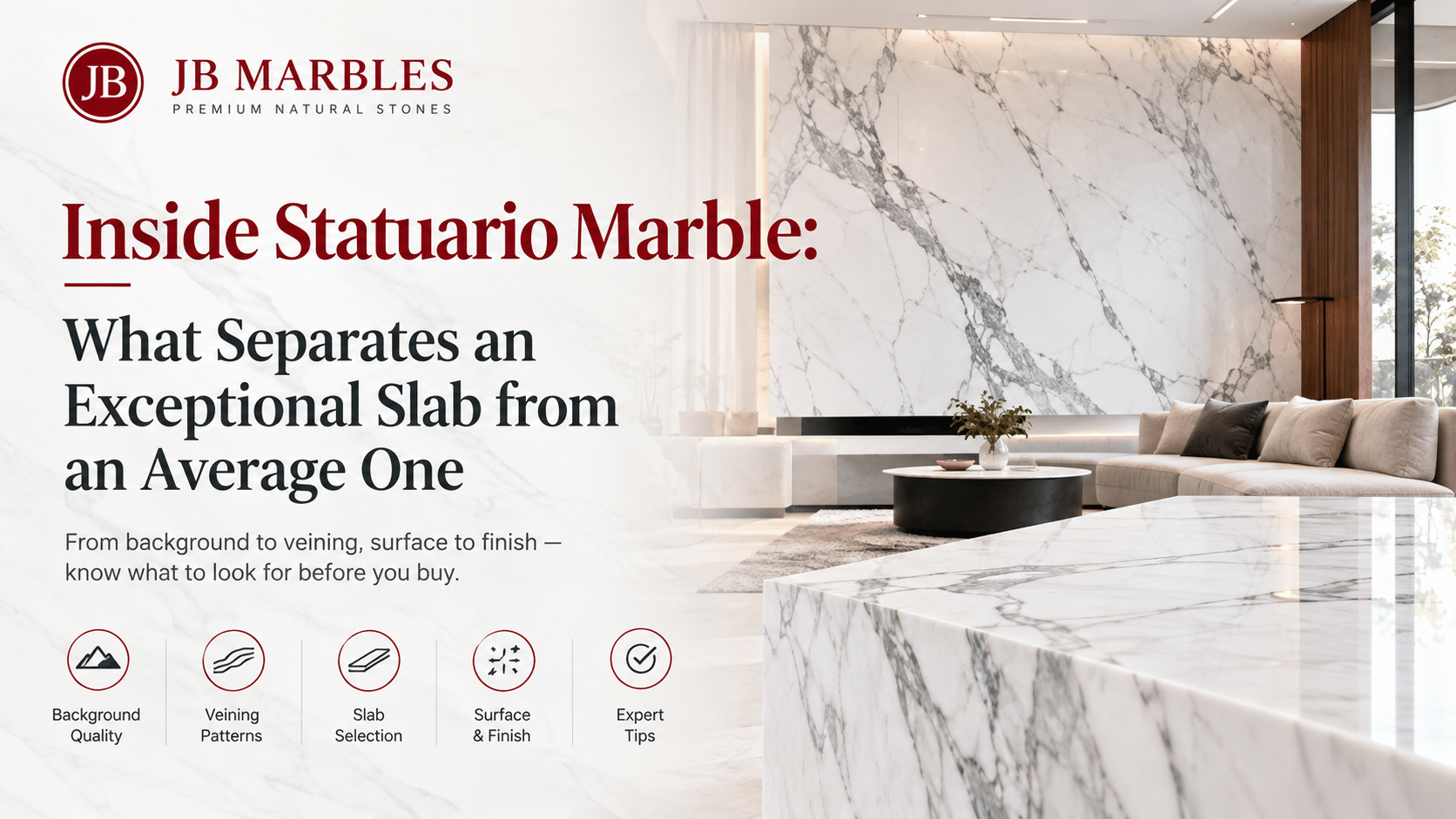
Quick answer: To compare Statuario marble before buying, do not judge a slab only by how white it looks or how dramatic its veins appear in a photograph. Inspect the complete slab, compare the white background, study vein direction and continuity, check the surface for visible imperfections, review several slabs together, and then match the material to your project’s application and layout.
This guide is written for homeowners, architects, interior designers, builders and project buyers who need to make a confident Statuario marble selection. It focuses on the visual and practical checks that matter before purchase, fabrication and installation.
For the actual material, you can also explore Statuario Marble by JB Marble and use this guide as a checklist when comparing available slabs.
How Do You Compare Statuario Marble Quality Before Buying?
Short answer: Compare Statuario marble in a fixed order: application → full slab → background → veining → surface condition → slab dimensions → finish → multi-slab consistency → fabrication and installation requirements. This prevents a visually attractive vein from distracting you from other important buying factors.
Statuario is valued for a bright, refined background and distinctive natural movement. However, “premium” should not mean simply “whitest” or “most heavily veined.” A good selection is the slab that gives the right combination of appearance, usable area, natural character and technical suitability for the intended project.
What Makes Statuario Marble Different From Ordinary White Marble?
White marble is a broad category, while Statuario is chosen for a more distinctive visual effect. Depending on the particular block and slab, the pattern can range from refined grey movement to stronger contrasting veins. That variation is exactly why slab-by-slab inspection matters.
For a luxury interior, the stone should work with the architecture rather than compete with it. A dramatic slab may be ideal for a feature wall or bookmatched installation, while a calmer slab may work better across a larger floor area.
Therefore, quality comparison should always consider the actual project context. The best-looking slab in isolation is not automatically the best slab for every application.
How Do You Check the White Background of Statuario Marble?
Place the slab where possible under lighting that is reasonably similar to the final project. A showroom light can make a stone look different from daylight or warm architectural lighting. The goal is not to force every slab to look identical; it is to understand its natural character before purchase.
Look for Overall Background Tone
Stand back from the slab and evaluate it as a complete surface. Do not judge the background from a small close-up alone. The overall impression matters because the stone will be viewed from different distances after installation.
Check Background Against the Veins
A clean background can make the natural veins appear more defined. However, the contrast should suit the design. Strong movement may become the visual centre of a room, while softer movement can provide a more restrained luxury effect.
Compare More Than One Slab
If multiple slabs are available, place them side by side or review them in sequence. This helps you understand natural variation before you commit to a quantity for the project.
How Do You Judge Statuario Marble Veining Quality?
Veining is often the first thing buyers notice in Statuario marble. Yet it is also one of the easiest areas to judge incorrectly. A dramatic photograph can make a small section of stone look impressive, while the full slab may have a very different visual balance.
1. Vein Direction
Notice whether the major veins run vertically, diagonally, horizontally or in several directions. The direction can influence the final design, especially on feature walls, staircases and long counters.
2. Vein Contrast
Compare how strongly the veins stand against the background. High contrast creates a stronger statement; lower contrast can feel more subtle. Neither is automatically better.
3. Natural Movement
Step back and look at the slab as a whole. The movement should be judged at the same scale at which people will experience the finished space.
4. Vein Continuity
Follow the major veins across the slab. Ask how they may continue, terminate or change when the slab is cut. Continuity becomes particularly important when a large surface is intended to read as one visual composition.
5. Vein Spacing
Observe the distance between major veins and secondary movement. A balanced pattern can make the stone easier to coordinate with furniture, lighting and architectural lines.
Is More Dramatic Veining Always Better in Statuario Marble?
No. The right amount of movement depends on the application, room size, surrounding materials and design goal. A bold slab can be excellent for a statement wall but may be visually overwhelming across every surface.
For example, a luxury foyer with a carefully framed feature wall may benefit from pronounced movement. In contrast, a large residential floor may need a more controlled pattern so the architecture, furniture and lighting remain visually balanced.
Before selecting a highly dramatic slab, ask three questions:
- Will the vein direction work with the planned layout?
- Will the movement complement the furniture, cabinetry and lighting?
- Will the stone still look balanced when repeated across several slabs?
These questions turn a visual preference into a practical buying decision.
What Surface Defects Should You Check Before Buying Statuario Marble?
Natural stone is not a factory-made material. Its natural characteristics can vary. Therefore, the purpose of inspection is not to demand artificial uniformity; it is to understand the actual slab and make an informed decision.
-
1. Check the Face of the Slab—Review the visible surface carefully. Look for areas that may require attention during fabrication or installation.
-
2. Inspect Edges and Corners—Edges can experience handling damage during transport and fabrication. Check the slab condition before final acceptance.
-
3. Ask About Repairs or Filled Areas—If a repaired or filled area is visible, ask how it should be treated during cutting, polishing and installation. The correct decision depends on the material and intended use.
How Should You Compare Multiple Statuario Marble Slabs?
This is especially important when a project needs several slabs. Natural variation means two slabs from the same general material category may not look identical. Reviewing them together helps the design team decide where each slab should be placed.
| What to Compare | What to Look For | Why It Matters |
|---|---|---|
| Background | Overall white tone and visual consistency | Sets the base appearance of the interior |
Major veins | Direction, contrast and continuity | Influences the focal character of the space |
Secondary movement | Density and spacing | Changes how calm or dramatic the slab feels |
Surface | Cracks, fissures, pits, repairs and chips | Helps identify fabrication and application considerations |
Finish | Polished, honed or other available finish | Affects appearance and maintenance expectations |
Why Is Full-Slab Inspection Better Than Choosing From a Sample?
A sample is useful for understanding colour and general character, but it is not a substitute for viewing the actual slab when the stone has strong natural movement.
This matters even more for luxury projects where a single vein may become a major design element. Before purchase, ask to see the slabs that will actually be allocated to the project whenever practical.
Catalogue photographs can also be useful for initial browsing, but the final decision should be based on the material available for your project and the conditions under which you will use it.
How Do You Check Statuario Marble for Bookmatching?
Bookmatching can turn Statuario marble into a strong architectural feature. However, the effect depends on choosing and sequencing the slabs correctly. The fabrication team should know the design intent before cutting begins.
- Identify the slab pair. Confirm which slabs will be used together.
- Map the major veins. Mark the main movement and its direction.
- Confirm the centreline. Decide exactly where the mirrored composition will meet.
- Place cut-outs carefully. Coordinate doors, niches, basins and other openings with the natural pattern.
- Approve the layout before fabrication. Review the proposed sequence before the slabs are cut.
Which Statuario Marble Applications Need the Most Careful Vein Selection?
Feature Walls
Bookmatched Panels
Staircases
Large Floors
Vanity and Counter Surfaces
How Does Slab Size Affect Statuario Marble Quality Selection?
A slab that looks excellent may still be unsuitable for a specific application if its usable dimensions do not support the required cuts. Conversely, a slightly less dramatic slab may deliver a better result if it allows the intended layout to be produced with less disruption to the natural movement.
Before buying, compare the slab dimensions with the project’s drawings. For important surfaces, involve the fabricator or design team early so the stone is selected with the actual cutting plan in mind.
Does Statuario Marble Finish Change How the Veining Looks?
A polished finish can create a reflective appearance and make colour and movement read differently under light. A honed finish can produce a softer, more muted visual effect. The right choice depends on the application, design intent and maintenance expectations.
Do not approve the finish only from a generic description. Ask to see a relevant sample or finished reference and discuss the choice with the supplier and fabricator.
What Should Architects and Interior Designers Confirm Before Approving Statuario Marble?
Before finalising your marble, ask the supplier about:
- Project area and intended application
- Actual slab numbers or identification
- Full-slab photographs or on-site inspection
- Background tone and natural movement
- Major vein direction
- Bookmatch or vein-matching requirements
- Slab dimensions and thickness
- Finish and edge treatment
- Cut-out locations
- Fabrication sequence
- Installation method and joint planning
- Cleaning and maintenance expectations
For design-led projects, the earlier the stone is coordinated with the drawings, the easier it becomes to preserve the natural pattern.
What Are the Most Common Mistakes When Buying Statuario Marble?
The most common mistake is choosing from a photograph or small sample without checking the actual slab and intended layout. Other mistakes include judging quality only by whiteness, ignoring vein direction, buying slabs individually without comparing them together, and delaying layout planning until after fabrication.
Choosing the Whitest Slab Automatically
White background is important, but the entire composition matters. A slightly different white tone can be the better choice if its veining and layout suit the project.
Choosing the Boldest Veins Automatically
Strong movement can be beautiful, but it should support the room rather than overpower every other design element.
Ignoring the Cut Plan
A slab should be judged in relation to what will be cut from it. A dramatic vein can lose its impact if the key area is removed by a cut-out.
Buying Slabs One by One
When multiple slabs are required, compare them together. Natural variation can become obvious only after the slabs are placed in sequence.
Skipping Professional Inspection
For significant projects, involve the fabricator and design team before final approval so visual selection and technical requirements are considered together.
What Is the Best Statuario Marble Buying Checklist?
Use this checklist before confirming your purchase: actual slab inspected, background approved, veining approved, surface reviewed, dimensions confirmed, finish confirmed, quantity checked, slab sequence planned and fabrication requirements understood.
- 1. Confirm the exact material. Make sure the stone being quoted and the stone being inspected are the same material.
- 2. Inspect the full slab. Review it from both close and normal viewing distances.
- 3. Approve the background. Check the overall white tone under relevant lighting.
- 4. Approve the veining. Review direction, contrast, continuity and movement.
- 5. Inspect the surface. Note visible natural features, repairs, chips or other conditions.
- 6. Measure usable dimensions. Compare the slab with the project drawings.
- 7. Confirm finish. Match the finish to the intended application and maintenance plan.
- 8. Compare all required slabs. Review them together before final selection.
- 9. Plan fabrication. Confirm cut-outs, edge profiles, joints and bookmatch requirements.
- 10. Document approval. Record the selected slabs and approved layout before cutting.
Where Can You Compare Statuario Marble Slabs Before Buying?
JB Marble presents itself as a premium natural-stone destination and offers a collection of marble and other natural stones. Buyers considering Statuario marble can use the selection process described in this guide when reviewing available material.
For product-specific information, visit the JB Marble Statuario Marble page. For a purchase decision, ask for the actual available slabs, dimensions, finish and project suitability rather than relying on a generic photograph.
How Should You Compare Statuario Marble With Other White Marbles?
| Material | Typical Visual Direction | Selection Focus | Common Design Role |
|---|---|---|---|
| Statuario Marble | Light background with distinctive natural movement | Vein character and full-slab composition |
Luxury statements and refined feature surfaces |
| Carrara Marble |
White to grey with softer, recognisable movement | Background and grey vein balance |
Classic and contemporary surfaces |
| Calacatta Marble |
Light background with expressive movement | Vein scale and contrast | Feature-led luxury interiors |
| Other White Marble |
Varies by material and source | Exact slab character and suitability |
Depends on application and design |
These categories describe general visual directions, not a guarantee that every slab will look the same. Natural stone varies, so the actual slab remains the most useful reference.
Frequently Asked Questions About Statuario Marble Quality and Veining
What should I check first when buying Statuario marble?
Start with the complete slab. Then check the white background, veining, surface condition, thickness, finish and whether multiple slabs work together for the planned layout.
How can I tell if Statuario marble has good veining?
Good veining is not simply the boldest veining. Compare vein direction, continuity, contrast, spacing and how the pattern works across the full slab and planned installation.
Should I choose the whitest Statuario marble slab?
Not always. A strong Statuario selection balances background tone, veining, surface condition, slab size and the visual requirements of the project.
Why should I inspect the entire Statuario marble slab?
Because a small sample can hide natural movement and shade changes. Full-slab inspection gives a more reliable view of the stone you are actually buying.
How should I plan Statuario marble for bookmatching?
Plan bookmatching from the actual slab pair. Check vein direction, slab sequence, centreline, cut positions and visual continuity before fabrication.
Where can I compare Statuario marble slabs?
JB Marble offers a natural-stone showroom experience where buyers can discuss material selection and compare available slabs for their project.
Ready to Compare Statuario Marble Slabs?
JB Marble — Luxurious Living.
Speak with JB Marble about available Statuario marble, slab selection, project requirements and the right approach for your planned application.